
By EIV Diagnostics · August 26, 2026
What Is PCR? A Plain-Language Guide to DNA Amplification
Discover how PCR, a powerful DNA amplification technique, transforms tiny genetic samples into millions of copies for rapid analysis.
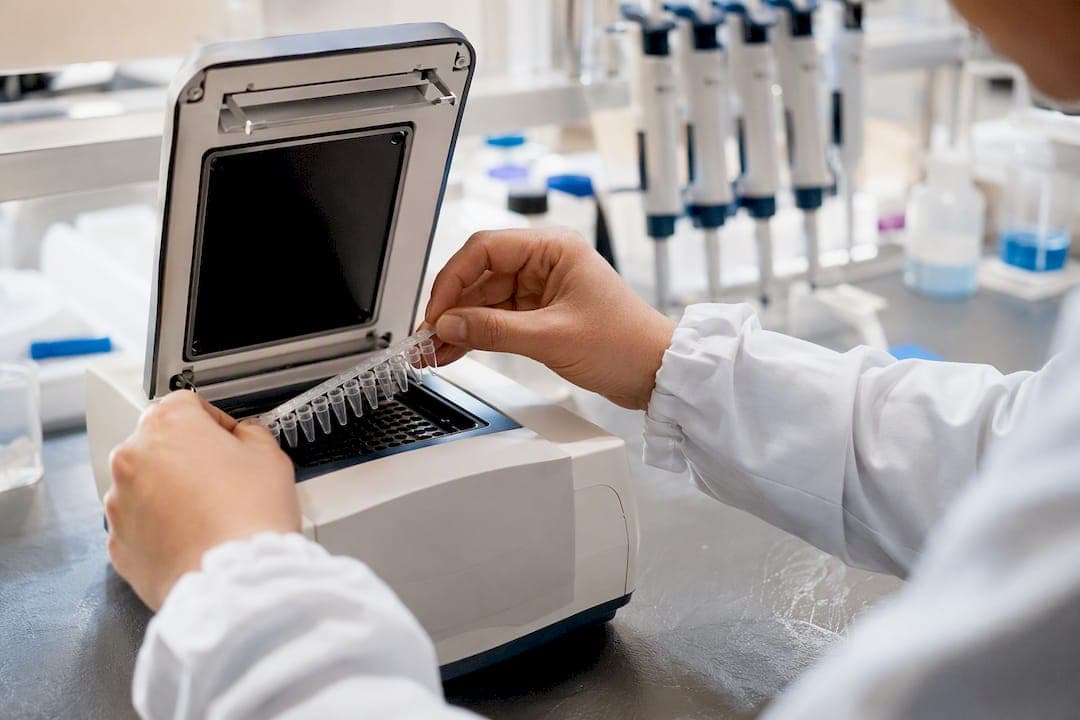
PCR, or polymerase chain reaction, is a lab technique that copies a specific piece of DNA over and over until there’s enough of it to detect, study, or analyze. A single reaction can turn a barely visible trace of genetic material into millions to billions of identical copies, all within a few hours, using nothing more exotic than heat, cold, and a handful of chemical ingredients.
The whole process runs inside a machine called a thermocycler, which automates repeated rounds of heating and cooling so a lab technician doesn’t have to babysit test tubes all day. Here’s what that gets you:
- Detection power: enough amplified DNA to spot a virus, bacterium, or genetic mutation that would otherwise be invisible
- Speed: results in hours rather than the longer times older culture-based methods required
- Precision: the ability to target one exact DNA sequence out of billions in a sample
- Versatility: the same core chemistry powers COVID testing, cancer screening, paternity tests, and criminal forensics
PCR underpins most of modern molecular diagnostics. Without it, a lot of what pathology labs do today simply wouldn’t be possible.
Key Takeaways
PCR amplifies a targeted DNA sequence exponentially through repeated heat cycles, and its reliability depends on both the chemistry and the lab discipline behind it.
| Point | Details |
|---|---|
| PCR amplifies DNA exponentially | A single template molecule can become over a billion copies after roughly 30 cycles of heating and cooling. |
| Three-step cycle drives amplification | Denaturation, annealing, and extension each run at a distinct temperature and repeat 25 to 40 times per reaction. |
| Reagent quality determines results | Primers, Taq polymerase, and buffer conditions all have to be matched to the target sequence for accurate amplification. |
| Sensitivity cuts both ways | PCR can detect trace pathogens early, but the same sensitivity makes contamination-driven false positives a real risk. |
| Interpretation requires clinical context | Ct values and panel results need a clinician’s judgment, not a standalone reading, to guide treatment decisions. |
| EIV Diagnostics applies PCR with pathologist oversight | Molecular pathology testing includes board-certified pathologist review and mobile phlebotomy to protect specimen integrity. |
Table of Contents
- How Does PCR Work? The Three-Step Cycle Explained
- What Reagents and Equipment Does PCR Require?
- What Are the Different Types of PCR Testing?
- What Is PCR Used For? Real-World Applications
- What Are the Advantages and Limitations of PCR?
- How Should PCR Results Be Interpreted Clinically?
- What Lab Practices Keep PCR Results Reliable?
- How EIV Diagnostics Applies PCR in Everyday Testing
- A Publisher’s Note on Responsible PCR Testing
- Get PCR Testing Through EIV Diagnostics
- Sources
- FAQ
How Does PCR Work? The Three-Step Cycle Explained
PCR works by repeating a three-step temperature cycle that splits DNA apart, matches short DNA fragments to a target sequence, and then builds brand-new copies of that sequence. Run that cycle enough times, and a single DNA molecule becomes a mountain of identical copies.
The three phases of each cycle
- Denaturation (about 95°C): The reaction is heated to nearly boiling, which breaks the hydrogen bonds holding the two strands of the DNA double helix together. The double strand splits into two single strands, exposing the genetic sequence.
- Annealing (roughly 50°C to 72°C): The temperature drops, and short synthetic DNA fragments called primers latch onto matching sequences on each single strand. Primers act like bookmarks, marking exactly where copying should begin.
- Extension (roughly 72°C to 80°C): The temperature rises again, and an enzyme called DNA polymerase attaches to each primer and builds a new complementary strand, reading along the template in the 5’ to 3’ direction.
One full cycle takes only a minute or two. A standard PCR run repeats that cycle 25 to 40 times, and because each cycle doubles the number of DNA copies, the math turns explosive fast.
Statistic Callout: After just 10 cycles, one DNA molecule becomes roughly 1,000 copies. After 20 cycles, it’s over a million. By cycle 30, you’re looking at more than a billion copies of a sequence that started out too small to see.
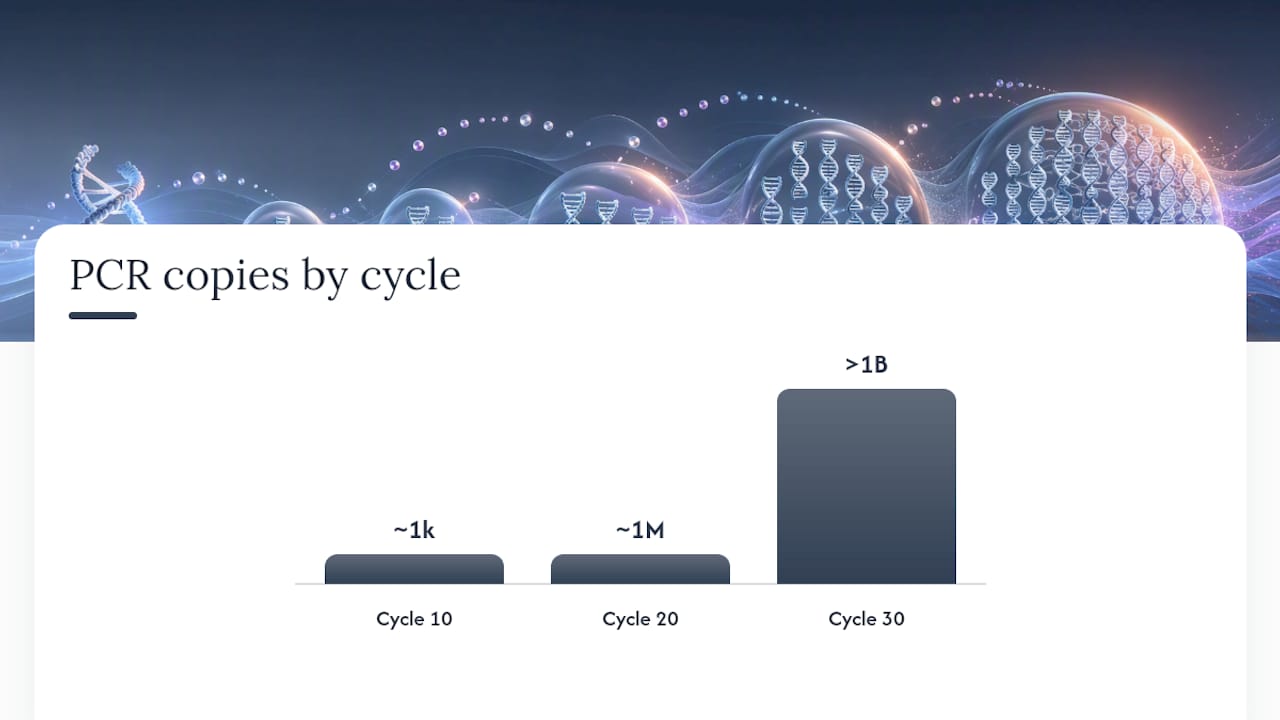
That doubling effect is the entire reason PCR works. Early cycles don’t feel productive because the absolute numbers are tiny, but exponential growth catches up quickly, and the back half of the run generates the overwhelming majority of the final DNA yield.
The thermocycler handles the repeated heating and cooling automatically, following a programmed profile so each of those 25 to 40 cycles happens at the right temperature for the right number of seconds. That automation is what makes PCR practical for a working lab. Nobody is manually adjusting a water bath every ninety seconds for two hours. A technician loads the reaction, sets the program, and the machine runs the entire cycle sequence unattended, typically finishing in a few hours depending on the number of cycles and the target sequence length.
What Reagents and Equipment Does PCR Require?
Every PCR reaction needs six core ingredients, and skipping or skimping on any one of them breaks the whole process. Understanding what each piece does makes it much easier to understand why PCR results can vary between labs, and why some tests require extra steps.
- Template DNA: the sample containing the target sequence you want to copy, extracted from blood, saliva, tissue, or a nasal swab
- Primers: two short synthetic DNA fragments, one for each strand, that mark the start and end points of the sequence to be copied
- dNTPs (nucleotides): the raw building blocks (A, T, C, G) that DNA polymerase strings together to build new strands
- DNA polymerase: the enzyme that actually assembles the new DNA strand; most PCR uses Taq polymerase, isolated from a heat-loving bacterium, because it survives the 95°C denaturation step without breaking down
- Buffer solution: a chemical environment, usually containing magnesium ions, that keeps the enzyme stable and active through dozens of temperature swings
- Thermocycler: the instrument that executes the programmed heating and cooling profile
Taq polymerase deserves a special mention. Ordinary enzymes from most organisms fall apart at high heat, which is exactly why PCR didn’t become practical until scientists identified a polymerase that could survive repeated exposure to near-boiling temperatures without denaturing.
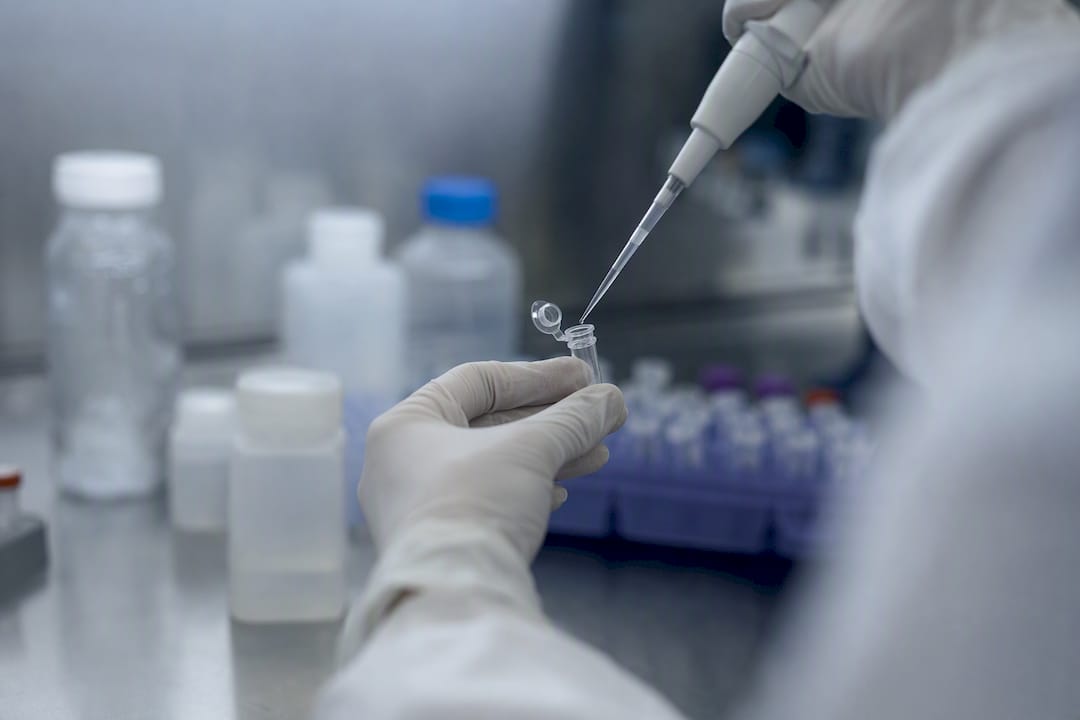
If the target is RNA rather than DNA, one extra step gets added at the front: reverse transcription. An enzyme called reverse transcriptase converts the RNA into a complementary DNA strand first, and then standard PCR proceeds from there. This variant is called RT-PCR, and it’s the reason respiratory virus testing (where the virus’s genetic material is RNA) requires a slightly different workflow than testing for a DNA-based pathogen.
Pro Tip: If you’re ever comparing lab reports and see “Ct value” or “RT-qPCR” on one and just “PCR positive/negative” on another, that’s not a discrepancy. It usually just reflects which variant of the technique the lab used and how they chose to report it.
What Are the Different Types of PCR Testing?
Conventional PCR, quantitative PCR, RT-PCR, and multiplex PCR all rely on the same core chemistry, but they answer different questions and report results differently. Picking the right variant matters as much as running the reaction correctly.
- Conventional (endpoint) PCR: amplifies the target and reports a simple yes or no, target detected or not, once the run finishes
- Quantitative PCR (qPCR / real-time PCR): measures amplification as it happens, cycle by cycle, and produces a Ct (cycle threshold) value indicating how many cycles it took to detect the target. A lower Ct generally means more starting material was present.
- RT-PCR: adds the reverse transcription step for RNA targets, used for RNA viruses and gene expression studies
- Multiplex PCR: runs several primer pairs in the same reaction to detect multiple targets simultaneously, which is how a single respiratory panel can screen for flu, RSV, and COVID in one test rather than three
- Digital PCR: partitions a sample into thousands of tiny individual reactions to count target molecules directly, used when labs need absolute quantification rather than a relative estimate
Multiplex testing has become especially common in respiratory illness season, when symptoms overlap enough that ordering three separate single-target tests would waste both time and sample volume. A respiratory PCR panel built on multiplex chemistry can flag the specific pathogen driving a patient’s symptoms in one run instead of several.
Digital PCR sits at the specialized end of the spectrum. It’s not what a routine diagnostic order uses, but it shows up in research and in cases where a lab needs to pin down an exact copy number, such as measuring how a tumor’s genetic markers shift over the course of treatment.
What Is PCR Used For? Real-World Applications
PCR shows up anywhere someone needs to detect, identify, or quantify a specific piece of DNA or RNA, which is why it spans infectious disease testing, oncology, basic research, and criminal forensics. Each field leans on the same chemistry but for a different practical reason.
- Infectious disease diagnostics: detecting pathogens like influenza, HPV, or H. pylori often days before symptoms peak, and doing it with a single-target assay or a broader panel depending on the clinical picture
- Cancer and genetic marker testing: identifying mutations that guide treatment decisions, since molecular testing results increasingly determine which targeted therapy a patient is a candidate for
- Research applications: cloning genes, preparing samples for sequencing, and genotyping organisms in academic and pharmaceutical labs
- Forensic analysis: amplifying short tandem repeat (STR) regions from crime scene evidence to generate a DNA profile, even from samples too degraded or scant for older techniques
The forensics use case highlights both PCR’s strength and its Achilles’ heel in the same breath. The technique’s sensitivity is exactly what lets investigators build a profile from a few skin cells left on a doorknob. That same sensitivity means low-copy-number samples are also more vulnerable to contamination and interpretation ambiguity, which is why forensic labs run additional confirmatory steps before treating a result as conclusive.
In the clinic, the choice between a single-target test and a multiplex panel usually comes down to how confident the ordering clinician is about the diagnosis going in. A patient with a classic H. pylori presentation might get a targeted PCR test built around one organism. A patient with vague respiratory symptoms during flu season is a better candidate for a broader panel that screens several pathogens at once. Neither approach is wrong. They’re just built for different levels of diagnostic certainty.
What Are the Advantages and Limitations of PCR?
PCR’s biggest strength, extreme sensitivity, is also its biggest liability, since a technique capable of detecting a handful of DNA molecules will occasionally detect the wrong ones. Understanding both sides keeps expectations realistic.
Where PCR excels:
- Detects pathogens earlier than culture-based methods, often before a patient becomes symptomatic
- Distinguishes closely related organisms or gene variants with high specificity when primers are well designed
- Works on small or partially degraded samples that older techniques couldn’t process
Where PCR can mislead:
- A stray skin cell, airborne particle, or contaminated pipette tip can introduce enough foreign DNA to trigger a false positive
- PCR detects genetic material, not whether the organism it came from is alive or capable of causing illness, which matters clinically since remnants of a pathogen’s genetic material can persist after a person is no longer infectious
- Mismatched primers, sample inhibitors (substances in blood or soil that interfere with the reaction), and degraded template DNA can all produce unreliable amplification
Statistic Callout: Because PCR can amplify DNA present in quantities too small to measure by almost any other method, even a trace of contaminating genetic material, well below what a technician could see or smell, is enough to skew a result. That’s precisely why accredited labs build their entire workflow around preventing contamination before it happens rather than catching it after the fact.
None of this makes PCR unreliable. It makes PCR a technique that rewards careful lab practice and punishes sloppy technique more severely than most other diagnostic methods.
How Should PCR Results Be Interpreted Clinically?
A positive PCR result answers one question, whether a specific genetic sequence was present in the sample, and it’s the clinician’s job to decide what that means for the patient in front of them. Ct values, panel design, and the original diagnostic question all factor into that judgment.
- Single-target tests need a hypothesis going in. Ordering a PCR test for one specific pathogen only makes sense when the clinical picture already points toward that pathogen. A negative result on the wrong test tells you nothing useful.
- Multiplex panels shift the logic. Because a panel screens for several targets at once, it’s useful even when the diagnosis is genuinely uncertain, though a positive result on a panel still requires the clinician to weigh whether the detected organism explains the symptoms or is an incidental finding.
- Ct values are a clue, not a verdict. A lower Ct value generally suggests more genetic material was present at the start, but Ct values are assay- and platform-dependent and shouldn’t be compared across different tests or used alone to declare someone infectious or non-infectious.
- A positive result sometimes needs confirmation. When a result doesn’t match the clinical picture, or when the stakes of a false positive are high, labs and clinicians often order a second confirmatory test or correlate the result with symptoms, imaging, or other lab findings.
This is exactly where a PCR versus rapid antigen test comparison becomes useful for patients trying to understand why their doctor chose one test over another. Rapid tests trade some sensitivity for speed. PCR trades a longer turnaround for the ability to catch infections at much lower viral loads, which is part of why a negative rapid test sometimes gets followed up with PCR when suspicion remains high.
What Lab Practices Keep PCR Results Reliable?
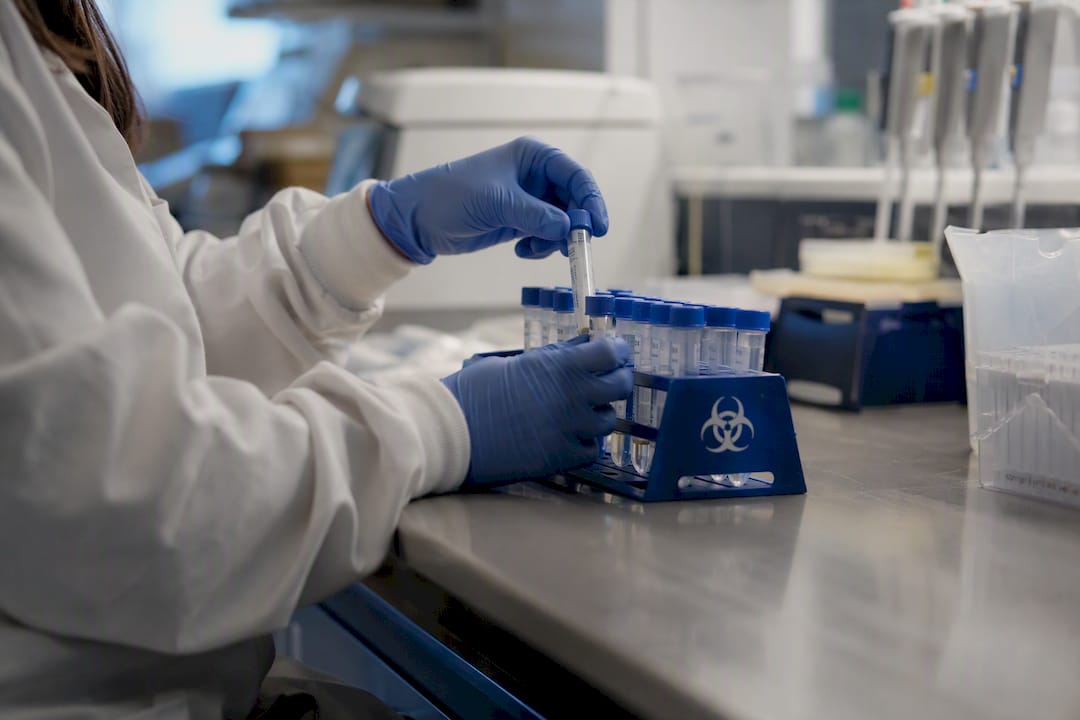
Reliable PCR results come from disciplined lab workflow just as much as from good chemistry, since the same sensitivity that makes PCR powerful also makes it vulnerable to contamination at every handling step. A handful of standard practices keep that risk in check.
- Careful sample collection and transport. Specimens need to reach the lab intact and at the right temperature; degraded samples yield weaker amplification and less reliable results.
- Positive and negative controls in every run. A negative control with no target DNA should stay negative. If it doesn’t, something in the reaction or the lab environment introduced contamination, and the whole batch gets flagged.
- Unidirectional workflow design. Accredited labs physically separate the areas where samples are prepped from the areas where amplified DNA is handled, since amplified DNA floating around a lab is a major contamination source if it drifts into a pre-amplification workspace.
- Accreditation and proficiency testing. Standards from bodies like CAP (College of American Pathologists) and CLIA (Clinical Laboratory Improvement Amendments) require labs to prove, on a recurring basis, that their PCR results match expected outcomes on blind test samples.
- Clear turnaround and reporting standards. Most PCR-based diagnostic results return within 24 to 72 hours, though complex panels or send-out tests can take longer, and results should include enough context (target, method, and any relevant Ct information) for a clinician to interpret them properly.
None of these steps are optional extras. They’re the difference between a PCR result you can trust and one that just looks convincing on paper.
How EIV Diagnostics Applies PCR in Everyday Testing
EIV Diagnostics runs PCR-based molecular pathology testing as part of its core diagnostic services, supporting both physicians ordering tests for patients and individuals who want to order testing directly. That work spans infectious disease panels, targeted pathogen assays, and molecular markers used in broader pathology workups.
- Board-certified pathologists review molecular results before they reach a provider or patient, adding a layer of clinical judgment beyond the raw Ct value or positive/negative call
- Mobile phlebotomy brings specimen collection to a patient’s home or office, which shortens the window between collection and processing and reduces the sample degradation risk that comes with long transport delays
- Instrument controls and certified staff follow the same accreditation-driven workflow standards, described above, that keep contamination risk low and results consistent run after run
- Direct-to-consumer and provider-ordered pathways mean a patient with a prescription and a self-pay patient without one can both access the same testing infrastructure
Pro Tip: If specimen quality is a concern, especially for temperature-sensitive samples, ask whether mobile phlebotomy is available for your test. Shorter transport time between collection and processing tends to mean better sample integrity, which directly affects how reliable the eventual PCR result is.
Rapid turnaround matters most when a treatment decision is sitting on the other side of a lab report, and that’s the standard EIV Diagnostics builds its molecular workflow around.
A Publisher’s Note on Responsible PCR Testing
Good PCR results start long before the thermocycler runs its first cycle. They start with how a sample is collected and how quickly it reaches a lab that treats contamination control as non-negotiable. That’s the standard EIV Diagnostics holds its molecular pathology work to, and it’s part of why mobile phlebotomy matters as much as the assay itself. If you have questions about a PCR result or need testing arranged, reach out to EIV Diagnostics directly.
— EIV Diagnostics
Get PCR Testing Through EIV Diagnostics
Most people trying to make sense of a PCR order face two frustrations: figuring out which test actually answers their clinical question, and finding a way to get sample collection done without rearranging their whole day around a lab visit. EIV Diagnostics solves both. Its molecular pathology services cover single-target and panel-based PCR testing, reviewed by board-certified pathologists, and available whether you’re a provider ordering for a patient or an individual self-paying without a prescription.

Sample collection happens on your terms through mobile phlebotomy, with a phlebotomist coming to your home or office instead of you driving to a draw station. That shorter path from collection to lab processing helps protect specimen integrity, which matters directly for PCR accuracy. To get started, contact EIV Diagnostics to discuss which molecular test fits your situation and schedule a mobile draw or an in-lab appointment.
This article is general information, not a substitute for advice from a qualified doctor. Consult a qualified healthcare professional about your own circumstances before acting on anything here.
Sources
- Genome
- Polymerase Chain Reaction (PCR) — StatPearls, NCBI Bookshelf
- Biochemistry, Polymerase Chain Reaction — NCBI Bookshelf
- PCR tests — MedlinePlus
FAQ
What Does PCR Stand For?
PCR stands for polymerase chain reaction, a lab method that copies a targeted DNA sequence into millions or billions of copies through repeated heating and cooling cycles.
How Long Does a PCR Test Take To Run?
A standard PCR reaction typically completes in a few hours inside a thermocycler, though total turnaround for a clinical result also depends on sample transport and lab processing time.
Can PCR Give a False Positive?
Yes. Because PCR is extremely sensitive, even a small amount of contaminating DNA, from a stray skin cell or a shared surface, can trigger a false positive, which is why accredited labs use strict contamination controls.
What Is the Difference Between PCR and Rapid Antigen Tests?
PCR detects genetic material and can catch infections at much lower levels, while rapid antigen tests detect viral proteins and return results faster but with lower sensitivity; see this comparison of PCR and rapid testing for more detail.
Does a Positive PCR Result Always Mean an Active Infection?
Not necessarily. PCR detects genetic material regardless of whether the source organism is still viable, so a positive result can sometimes reflect remnants of a past infection rather than a current active one.
Who Can Order a PCR Test?
Both healthcare providers and self-pay patients without a prescription can order PCR-based molecular testing through labs like EIV Diagnostics, depending on the specific test and applicable regulations.