
By EIV Diagnostics · September 27, 2026
Get a Good Faith Estimate: Avoid a $400 Surprise on Home Blood Draws
Typical home blood draw costs: $65–$150 for a visit plus $20 to hundreds for lab tests. Learn when Medicare pays and what to ask before you book.
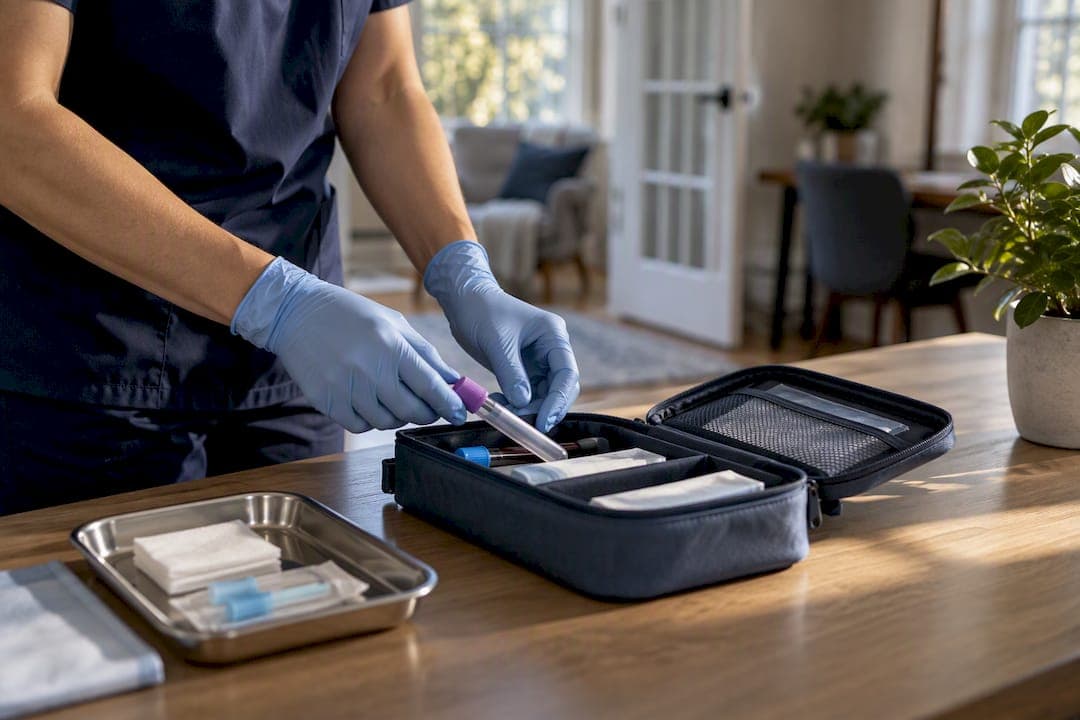
A typical mobile phlebotomy visit can start from $65, and that fee covers only the collection, not the lab testing itself. Test processing gets billed separately by the laboratory, often adding $20 to several hundred dollars depending on what’s ordered. Medicare rarely pays for a home draw unless you’re formally homebound under a physician’s care plan. If you’re paying out of pocket, ask for a written Good Faith Estimate before you schedule anything.
TL;DR:
- The typical visit fee for a mobile blood draw ranges from $65 to $150, usually depending on location, urgency, and service distance, while lab tests are billed separately and can cost from $20 to hundreds of dollars.
- Insurance coverage for home blood draws is limited and depends on medical necessity, with Medicare only covering visits for genuinely homebound patients enrolled in a physician-ordered home health plan.
- Most providers are required to give a written Good Faith Estimate before the appointment, which helps prevent surprise bills by clarifying both visit and lab test costs upfront.
- Additional charges such as rush processing, after-hours visits, or rural mileage add significantly to the base fee, and group bookings can lower the per-person cost.
- Confirming in-network status and obtaining prior authorization from insurers before the visit can reduce out-of-pocket costs and avoid unexpected expenses.
Table of Contents
- How Much Is a Home Blood Draw? A Quick Cost Breakdown
- What’s Included in the Visit Fee vs. the Lab Bill?
- What Factors Raise or Lower the Cost of a Home Blood Draw?
- Does Insurance or Medicare Cover Home Blood Draws?
- What Is a Good Faith Estimate and How Does It Protect You?
- When Does Paying for a Home Blood Draw Actually Make Sense?
- How Do You Schedule a Home Blood Draw Without Getting Surprised by the Bill?
- Why EIV Diagnostics Is a Reliable Source on This Topic
- What Do Real Home Blood Draw Fees Look Like?
- How Do You Pay for a Home Blood Draw?
- The Real Problem With How This Topic Gets Explained
- Book a Home Blood Draw With EIV Diagnostics
- Sources
- FAQ
How Much Is a Home Blood Draw? A Quick Cost Breakdown
The bill for a mobile blood draw has three moving parts, and confusing them is the single biggest source of sticker shock.
The visit fee itself, sometimes called a phlebotomy service fee, generally lands between $65 and $150 per stop. That range exists because it depends on your zip code, how far the phlebotomist has to drive, and whether the provider charges a flat rate or a mileage-adjusted one. EIV Diagnostics, for example, lists mobile phlebotomy starting from $65 for a standard visit, which sits at the lower end of what you’ll see nationally.
Lab testing is a separate charge entirely, priced per test or per panel by whichever laboratory processes your sample. A basic metabolic panel might run $20 to $50, while a specialized molecular or genetic panel can climb into the hundreds. In many cases, the lab charge ends up higher than the visit fee itself.
Common add-ons that catch people off guard include:
- Rush or stat processing fees for same-day results
- After-hours or weekend surcharges
- Extra mileage charges for rural or extended-distance visits
- Difficult-draw fees for pediatric patients or hard-to-access veins
What’s Included in the Visit Fee vs. the Lab Bill?
The mobile phlebotomy fee covers the phlebotomist’s time, travel to your location, and standard collection supplies like needles, tubes, and bandages. That’s it. It does not cover what happens to your blood after it leaves your arm.
The laboratory that processes your sample bills separately for test analysis, reagents, quality control, and the report your provider eventually reads. This is why two invoices are common:
- One invoice from the phlebotomy provider for the collection visit itself
- A second invoice from the reference laboratory that ran your specific tests
Some providers streamline this into a single combined bill, particularly when the same company owns both the mobile service and the lab. Others contract out to independent couriers and outside laboratories, which means you’ll likely see two separate charges land in your inbox or mailbox. Ask which setup applies to you before the appointment, not after.
What Factors Raise or Lower the Cost of a Home Blood Draw?
Four variables do most of the work in determining whether you land near $65 or closer to $150 and beyond.
- Distance and service area. Providers typically charge more for locations outside their core coverage zone, and rural addresses often carry a mileage surcharge on top of the base fee.
- Urgency. Scheduling a same-day or after-hours draw almost always triggers a premium over a standard weekday appointment booked a few days out.
- Test complexity and patient factors. A single tube for a basic panel costs less to collect and process than multiple draws for a complex workup, and pediatric or difficult-vein patients sometimes incur an added fee for extra time.
- Group or employer arrangements. Corporate wellness screenings, clinical trial site visits, or family bundling (multiple people at one address) frequently qualify for a lower per-person rate than a single standalone visit.
If your situation checks the boxes for standard, local, business-hours, single-panel testing, expect the lower end of the range. Stack urgency, distance, and complexity together, and the total moves up fast.
Does Insurance or Medicare Cover Home Blood Draws?
Coverage depends entirely on medical necessity, and the rules are stricter than most people assume.
Medicare Part B pays specimen collection fees and travel allowances only when the patient is genuinely homebound and the draw is part of a physician-ordered home health plan, using specific billing codes to justify the claim. Wanting convenience is not the same as meeting that bar. Medicare’s own guidance is explicit that routine blood draws alone typically don’t qualify a patient for home health coverage unless a physician has certified broader homebound status and ordered skilled services as part of a care plan.
Medicare’s specimen collection and travel allowance rules apply only to medically necessary draws for homebound patients enrolled in a physician-ordered home health plan, not to convenience-based mobile visits.
Private insurance is less predictable. Even when the laboratory itself is in-network, the mobile visit fee can still get billed as an out-of-network convenience charge, leaving you responsible for the full amount.
Before booking, take three concrete steps:
- Call your insurer directly and ask whether mobile phlebotomy is a covered benefit under your plan
- Confirm in-network status for both the phlebotomy provider and the laboratory separately
- Request prior authorization in writing if your plan requires it for home services
What Is a Good Faith Estimate and How Does It Protect You?
If you’re uninsured or paying self-pay, federal law requires providers to give you an itemized Good Faith Estimate before you’re billed. This isn’t optional courtesy. It’s a right established under the No Surprises Act, and providers generally must supply the estimate within three business days when you schedule at least three business days in advance.
The estimate matters because it gives you a number to hold the final bill against. If the actual charge comes in $400 or more above the Good Faith Estimate, you can file a dispute through the Patient-Provider Dispute Resolution process, which carries a modest $25 initiation fee.
Before your appointment:
- Ask for a written GFE covering both the collection visit and the anticipated lab processing charges
- Save the estimate somewhere you’ll actually find it again
- Compare it line by line against the final invoice once it arrives
When Does Paying for a Home Blood Draw Actually Make Sense?
Sometimes the fee is worth it without question. A patient recovering from surgery, managing a chronic condition with frequent monitoring, or genuinely homebound under a doctor’s care plan may qualify for coverage, and even when they don’t, the convenience often outweighs the cost.
Reasons that justify paying out of pocket include:
- Limited mobility or transportation that makes a clinic visit genuinely difficult
- Immunocompromised status where avoiding a waiting room reduces infection risk
- Time constraints that make a 15 to 20-minute home visit far more efficient than a half-day clinic trip
Pro Tip: If you need recurring draws, ask about employer wellness programs or clinical research scheduling. Group bookings at a single address or workplace routinely bring the per-visit rate down compared to a solo appointment.
How Do You Schedule a Home Blood Draw Without Getting Surprised by the Bill?
Booking takes five minutes. Avoiding a billing surprise takes five specific questions.
- Request a written, itemized Good Faith Estimate covering the visit fee and expected lab charges separately.
- Ask directly who bills for the test versus who bills for the visit, since these are often two different companies.
- Confirm whether the visit will be processed through insurance or handled as self-pay from the start.
- Verify in-network status for both the phlebotomy provider and the laboratory running your tests.
- Ask about specimen handling, expected turnaround time, the cancellation policy, and what identification or physician order you’ll need to have ready.
Providers like EIV Diagnostics can walk through mobile phlebotomy scheduling and pricing questions directly before you commit to a date.
Why EIV Diagnostics Is a Reliable Source on This Topic
Some laboratories offer mobile phlebotomy programs alongside molecular pathology, dermatopathology, and digital pathology services, staffed by board-certified pathologists who review the results your blood draw eventually produces. That combination matters here: a lab that both collects your specimen and interprets it has a direct stake in getting the billing conversation right upfront.
Some laboratories provide written estimates on request for patients booking mobile draws, whether the order comes from a physician or the patient is paying self-pay.
, and reflect the kind of transparency patients should expect from any provider handling both collection and diagnosis.
What Do Real Home Blood Draw Fees Look Like?
Numbers help more than ranges alone, so here’s what the fee structure tends to look like in practice across the industry.
A standard weekday visit for a single panel, scheduled a few days ahead, typically sits at the lower end of the market. That’s the baseline: no rush, no extra mileage, no complications. EIV Diagnostics prices its mobile phlebotomy starting from $65 for this kind of straightforward visit, which is representative of where the affordable end of the market clusters.
Move up the scale and the fee climbs with each added variable. A same-day request adds a rush surcharge on top of the base visit fee. An after-hours or weekend appointment adds another layer. A rural address well outside a provider’s normal coverage zone can add a mileage charge that pushes the total well past $100 before the lab bill even arrives.
Multiply visits also change the math. A family of three booking draws at the same address in one appointment window often pays less per person than three separate individual bookings would cost, since the phlebotomist’s travel time gets split across multiple collections instead of charged three separate times.
The pattern across providers is consistent even when the exact numbers differ: base fee for a routine, local, weekday visit; incremental fees stacked on top for urgency, distance, or complexity; and the lab testing charge arriving as a completely separate line item regardless of what the visit itself cost. Understanding that structure, rather than memorizing one number, is what actually protects you from a bill that looks nothing like what you expected.

How Do You Pay for a Home Blood Draw?
Most mobile phlebotomy providers accept the same payment methods you’d use at any medical office: credit and debit cards, health savings account or flexible spending account cards, and increasingly, online payment at the time of booking rather than after the visit.
For self-pay patients specifically, upfront payment is common and often expected, particularly for direct-to-consumer testing ordered without a physician’s prescription. EIV Diagnostics operates a self-pay testing option that lets patients order tests directly and see pricing before committing, which is the model most self-pay providers are moving toward given the Good Faith Estimate requirements now in place.
If your visit is being billed through insurance, payment structure works differently. You may pay a copay or nothing upfront, with the balance settled between your insurer and the provider afterward, though you’re still on the hook for anything that falls outside your coverage or counts toward your deductible.
A few practical points worth confirming before you pay anything:
- Ask whether payment is due at the time of the visit or after the lab results are billed
- Find out if the provider offers payment plans for larger lab charges, since some diagnostic panels run into the hundreds of dollars
- Check whether HSA or FSA funds can be applied directly, which effectively reduces your out-of-pocket cost using pre-tax dollars
If you’re dealing with an insurance dispute over a home draw bill, services like ClaroClaim’s eligibility verification can help sort out whether a charge should have been covered in the first place before you pay it outright.
The Real Problem With How This Topic Gets Explained
Most advice about home blood draw costs treats the visit fee like it’s the whole story. It isn’t, and treating it that way is exactly how people end up blindsided by a second bill three weeks later from a laboratory they never spoke to.

The visit fee is the easy, predictable part. The variable that actually determines your total cost is the lab testing charge, and that number depends entirely on what gets ordered, which insurers rarely explain clearly before the draw happens. Conventional guidance also underplays how narrow Medicare’s homebound requirement really is. People assume “I have trouble getting around” qualifies. It usually doesn’t, not without a physician-certified care plan behind it.
If there’s one thing worth prioritizing above everything else in this guide, it’s the Good Faith Estimate. Not because it’s a nice courtesy, but because it’s the only document that puts a specific number in writing before you’re financially committed. Everything else, distance fees, rush charges, panel pricing, is negotiable or predictable once you have that estimate in hand. Without it, you’re guessing.
— EIV Diagnostics
Book a Home Blood Draw With EIV Diagnostics
Some providers offer self-pay and insured patients a straightforward alternative to guessing at mobile phlebotomy pricing: a written cost estimate before you schedule, not after you’re billed.
Requesting an estimate takes a few minutes, and it costs you nothing to compare it against quotes from other providers before deciding. If the numbers line up with what you read here, and the scheduling window works for you, booking a visit is the next step. Head to the mobile phlebotomy page to check availability and request your itemized Good Faith Estimate directly.
Sources
This article is general information, not a substitute for advice from a qualified doctor. Consult a qualified healthcare professional about your own circumstances before acting on anything here.
FAQ
How Much Does a Mobile Phlebotomist Charge Per Draw?
Mobile phlebotomy visit fees typically range from about $65 to $150 depending on location and urgency, with EIV Diagnostics starting from $65 for a standard visit. That fee is separate from whatever the laboratory charges to process the actual tests.
Does Insurance Cover At-Home Blood Work?
Coverage varies by insurer and depends on medical necessity rather than convenience alone. Even when the laboratory is in-network, some plans bill the mobile visit itself as an out-of-network convenience charge, so calling ahead to verify benefits matters.
How Much Does It Cost to Have Blood Drawn Without Insurance?
Self-pay patients should expect the standard visit fee plus separate lab testing charges, and providers are required to supply a written Good Faith Estimate before the appointment. That estimate is your best protection against an unexpectedly high final bill.
Will Medicare Pay for a Home Blood Draw?
Medicare only reimburses specimen collection and travel for homebound patients under a physician-ordered home health plan, not for convenience-based scheduling. A routine blood draw by itself generally does not meet the threshold for home health coverage.
What Should I Ask Before Booking a Mobile Blood Draw?
Ask for an itemized Good Faith Estimate, confirm whether the visit and the lab testing are billed separately, and verify in-network status for both the provider and the laboratory. Providers such as EIV Diagnostics can walk through pricing and scheduling details directly before you commit.