
By EIV Diagnostics · October 9, 2026
77–97% Sensitive Pertussis PCR: Timing, Ct, and Swab Tips for Clinicians
CDC aligned explainer for clinicians: when pertussis PCR is most accurate, how Ct and nasopharyngeal swab technique change interpretation, and key lab checks.
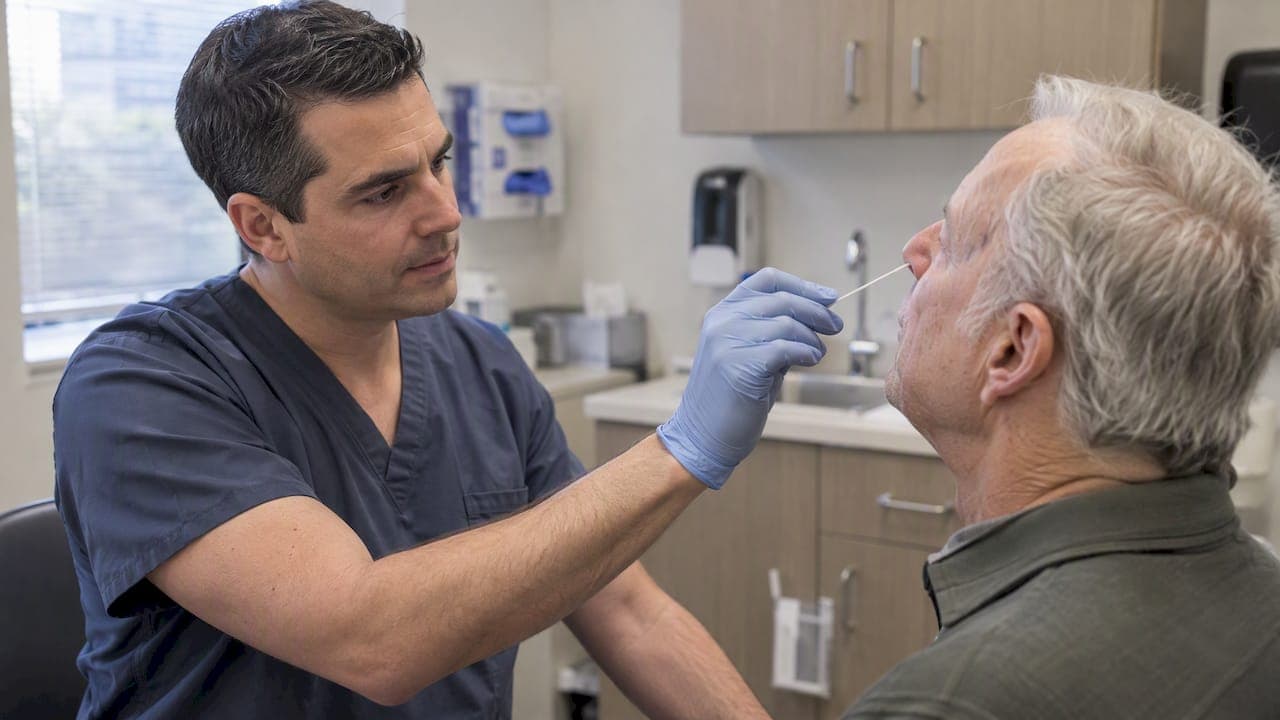
Pertussis PCR detects Bordetella pertussis DNA from a nasopharyngeal specimen and is the fastest, most sensitive test for diagnosing whooping cough early in illness. It works best in the first one to three weeks after cough onset, and sensitivity drops after four weeks, so results always need to be read alongside symptoms, exposure history, and the specific assay a lab used.
TL;DR:
- Test during the first three weeks of cough; sensitivity falls after week four, and five days of antibiotics can make PCR uninformative.
- A posterior nasopharyngeal aspirate is preferred; if using a swab, choose polyester, rayon, or nylon, because cotton and calcium alginate can inhibit PCR.
- Single target IS481 assays can produce false positives from related Bordetella species; ask whether labs add another target and how they interpret borderline Ct results.
- For infants, pregnant patients, or close contacts of vulnerable people, clinicians should start empiric antibiotics when suspicion is strong, without waiting for PCR results.
- A negative result does not exclude pertussis after late testing or antibiotics; equivocal or discordant results may need culture, serology, or clinical judgment.
Table of Contents
- What the pertussis PCR test is and when to use it
- Optimal timing for testing and how antibiotics affect results
- Specimen collection and transport: what to use and what to avoid
- How labs run pertussis PCR and what the report terms mean
- Interpreting PCR results: positives, negatives, equivocal, and common pitfalls
- Clinical steps after testing: treatment, reporting, and infection control
- EIV Diagnostics: laboratory quality practices and how we support clinicians and patients
- Expert perspective: trade-offs and a clinician-lab partnership
- Order pertussis testing or schedule a specimen draw
- FAQ
- Sources
What the pertussis PCR test is and when to use it
PCR identifies fragments of bacterial DNA rather than culturing a live organism, which is why results come back in hours instead of days. That speed, paired with high sensitivity, is why PCR has become the preferred diagnostic test for pertussis in most clinical settings.
PCR is intended for symptomatic patients whose cough pattern fits pertussis, not for screening contacts who feel fine. Testing asymptomatic people is not recommended for post-exposure decisions, largely because a positive result in someone without symptoms is harder to interpret and raises the odds of a false signal.
Three tools cover different needs:
- PCR gives rapid, sensitive detection early in illness, when it matters most for starting treatment.
- Culture remains the most specific method and the reference standard for confirming a strain, but it grows slowly and demands precise transport.
- Serology becomes more useful later in the illness, once antibody levels have had time to rise.
Optimal timing for testing and how antibiotics affect results
Timing drives accuracy more than almost any other factor in pertussis diagnosis. PCR sensitivity is highest from the first through third week of cough and stays reasonably useful into week four, after which detectable DNA drops off sharply as the bacterial load clears.
Antibiotics complicate the picture too. Once a patient has taken five or more days of appropriate antibiotic therapy, PCR is unlikely to add useful information because the drug has already reduced bacterial DNA below detectable levels.
- Test within the first three weeks of cough for the best chance of an accurate result.
- Treat empirically in high-risk patients rather than waiting on results if clinical suspicion is strong.
- Shift toward culture or serology once the cough has lasted a month or longer, since PCR loses its edge at that point.
Specimen collection and transport: what to use and what to avoid
Collection technique determines whether a PCR result is trustworthy, and small errors here cause a disproportionate share of false negatives. A nasopharyngeal aspirate is the preferred specimen because it pulls in more respiratory secretions from the posterior nasopharynx, where B. pertussis concentrates.
- Choose a posterior nasopharyngeal swab with a polyester, rayon, or nylon flocked tip when an aspirate is not feasible.
- Pass the swab along the floor of the nasal cavity to the posterior nasopharynx, not just inside the nostril.
- Rotate gently and hold for several seconds to collect enough cellular material before withdrawing.
- Place the swab in the transport medium specified by the testing laboratory and label it immediately.
- Ship at the temperature the lab requires, usually refrigerated, to preserve DNA integrity in transit.
Cotton-tipped and calcium alginate swabs inhibit the PCR reaction itself, and throat or anterior nasal swabs simply miss the site where the organism lives. Both choices routinely produce false negatives even when the patient is genuinely infected.
Pro Tip: Ask whoever performs the collection to confirm the swab material before the draw; a five-second check avoids a wasted specimen and a second visit.
How labs run pertussis PCR and what the report terms mean
Most pertussis PCR assays target a DNA sequence called IS481, which is highly sensitive but can cross-react with related species such as Bordetella holmesii and Bordetella bronchiseptica. Labs that run multi-target assays, adding a second gene target alongside IS481, improve specificity and cut down on that cross-reactivity.

Reports often include a cycle threshold, or Ct, value. Ct reflects how many amplification cycles were needed to detect DNA: a low Ct means more DNA and a stronger signal, while a high Ct means very little DNA was present, which some labs report as detected, equivocal, or indeterminate depending on their cutoffs. Our Ct value guide explains how that number translates into a clinical decision.
Within the first one to four weeks of symptom onset, PCR sensitivity for pertussis has ranged from 77% to 97% across studies, a spread wide enough that the specific assay and collection quality matter as much as the test itself.
- There is no single FDA-standardized pertussis PCR assay used across all laboratories.
- Ask your lab which gene targets it uses and whether it confirms positives with a second target or culture.
- A lab’s validation practices affect how much weight to put on a borderline Ct value.
Interpreting PCR results: positives, negatives, equivocal, and common pitfalls
A positive PCR in a symptomatic patient tested within the early window usually supports a pertussis diagnosis, but the Ct value and clinical picture still matter. A very high Ct paired with mild or atypical symptoms deserves a second look rather than automatic confirmation.
- False positives can stem from vaccine-related or environmental DNA contamination, especially with single-target assays that lack a confirmatory step.
- False negatives usually trace back to testing too late in the illness, poor swab technique, or recent antibiotic exposure.
- Our accuracy overview walks through how sensitivity and specificity trade off across different testing scenarios.
- When a result comes back equivocal, repeat testing, add culture or serology, or lean on clinical judgment rather than treating the number alone as an answer.
Laboratories that validate their PCR assay against culture and maintain ongoing quality assurance catch contamination issues before they reach a patient’s chart, which is one reason the same clinical specimen can produce different confidence levels depending on which lab runs it.
Clinical steps after testing: treatment, reporting, and infection control
Pertussis care often cannot wait for a lab result. CDC guidance supports starting empiric macrolide therapy based on history and risk factors alone, particularly for infants, pregnant patients, and anyone in close contact with a vulnerable person, rather than holding treatment until PCR confirms the diagnosis.
- Start empiric antibiotics in high-risk patients when clinical suspicion is strong, even before results return.
- Report confirmed and suspected cases to local public health authorities, since reporting rules trigger contact tracing and outbreak response.
- Seek culture confirmation during outbreaks, where strain-level data helps track transmission.
- Consider alternative antibiotics and consult public health if a patient’s illness pattern suggests macrolide resistance, since PCR alone typically does not detect resistance mutations without additional sequencing.
A negative result in a patient with classic symptoms and known exposure doesn’t rule out pertussis outright, especially late in the cough or after antibiotics. Clinical judgment, not the test alone, decides the next step.
EIV Diagnostics: laboratory quality practices and how we support clinicians and patients
Reliable pertussis PCR depends on practices that happen before and after the test itself: running positive and negative controls with every batch, participating in proficiency testing, and revalidating the assay whenever a reagent or protocol changes. A lab that skips these steps can report a number with confidence it hasn’t earned.
We run molecular pathology testing under pathologists and pair it with mobile phlebotomy so a correctly collected nasopharyngeal specimen doesn’t depend on a patient finding time for a separate clinic visit. We also offer self-pay testing for people without a current provider order, alongside standard clinician-ordered workflows.
- We support molecular testing, dermatopathology, digital pathology, and clinical pathology services from one lab, which helps keep result formatting and turnaround consistent across specimen types.
- Our mobile phlebotomy option brings specimen collection to a home or office, improving convenience and potentially reducing the chance of a delayed or poorly timed draw.
Pro Tip: When you place an order, ask which PCR target your lab uses and how it reports borderline Ct values; that single question clarifies how to read a result before it arrives.
Expert perspective: trade-offs and a clinician-lab partnership
PCR earned its place as the default pertussis test because speed changes outcomes, but speed without good specimen technique and lab oversight produces numbers that look precise and aren’t. The honest reading is that the assay is only as strong as the swab, the transport, and the validation behind it.
Ask your lab directly which targets it uses, how it defines an equivocal Ct, and whether it confirms positives with a second method. That conversation matters more than the report itself.
— EIV Diagnostics
Order pertussis testing or schedule a specimen draw
We offer molecular pathology testing for pertussis and related respiratory pathogens, built around board-certified pathologists and a lab workflow designed for rapid, accurate reporting. For patients without a current order, our self-pay testing option provides a direct path to get tested without waiting on a referral.

- Request mobile phlebotomy so a trained professional collects your specimen at home or at work.
- Order through your provider or directly through our self-pay option if you’re testing on your own initiative.
- Expect rapid reporting once your specimen reaches our lab, with results communicated to your provider or directly to you.
For singers and other voice professionals managing a lingering cough alongside pertussis concerns, a structured vocal recovery protocol can help protect the vocal folds while the underlying infection is treated.
This article is general information, not a substitute for advice from a qualified doctor. Consult a qualified healthcare professional about your own circumstances before acting on anything here.
FAQ
What happens if you test positive for pertussis?
A positive PCR in a symptomatic patient tested early in illness generally supports starting or continuing antibiotic treatment and notifying public health authorities for contact tracing. Your clinician will weigh the Ct value and your symptom timeline alongside the result rather than treating the positive in isolation.
How long does a PCR for pertussis take?
Turnaround depends on the lab’s workflow and specimen transport, with some reference labs reporting results within a few hours once the specimen arrives. Most clinical settings see results returned within a day or two after collection.
What is the gold standard test for pertussis?
Culture is considered the reference standard for confirming Bordetella pertussis because of its high specificity, though it grows slowly and requires very precise specimen handling. PCR has become the more commonly used test in practice because it is faster and more sensitive, especially early in illness.
What are the three stages of pertussis?
Pertussis typically progresses through a catarrhal stage with mild cold-like symptoms, a paroxysmal stage marked by severe coughing fits often followed by a characteristic whoop, and a convalescent stage where coughing gradually fades. PCR testing is most accurate during the earlier stages, before bacterial DNA declines.
Sources
- Best Practices for Use of Polymerase Chain Reaction for Diagnosing Pertussis | CDC
- Evaluation of PCR for Diagnosis of Bordetella pertussis and Bordetella parapertussis Infections (PMC)