
By EIV Diagnostics · November 6, 2026
Drug Test Cutoff Levels: Federal Urine and Oral Fluid Tables
See the federal urine and oral fluid drug test cutoff levels in ng/mL, how screening differs from confirmation, and what a result near the cutoff means.
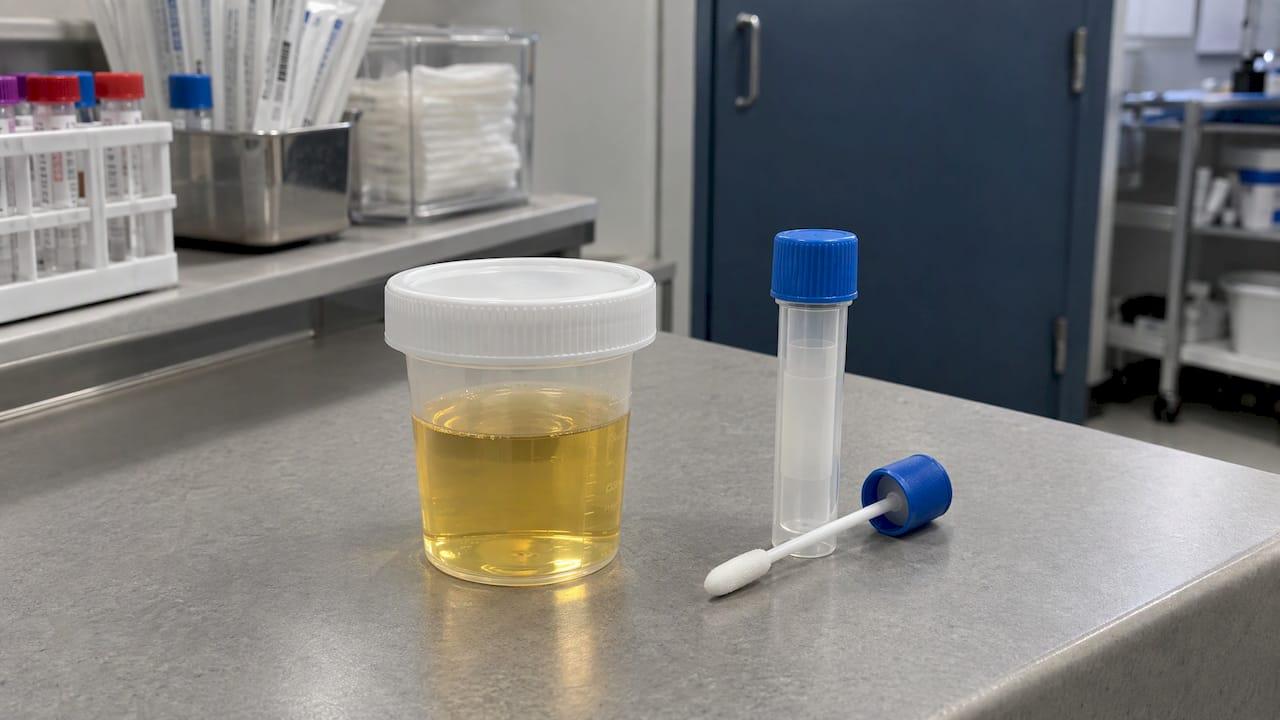
A drug test cutoff level is the concentration at or above which a lab reports a result as positive and below which it reports negative. For federal workplace urine testing, the marijuana metabolite cutoff is 50 ng/mL on the initial screen and 15 ng/mL on confirmation. Cocaine is 150 and 100 ng/mL. Amphetamines are 500 and 250 ng/mL. This guide gives the full tables, explains why screening and confirmation use different numbers, and shows how clinical testing differs from workplace testing. EIV Diagnostics is an independent laboratory in Fresno, CA, and we wrote it for patients, employers and providers who need to read a lab report with confidence.
TL;DR
- A cutoff is a reporting threshold. A result below it is reported as negative, even if some drug is present, and a result at or above it moves to confirmation or is reported positive.
- Testing happens in two steps: an immunoassay screen first, then a more specific confirmation (GC/MS or LC/MS) with its own, usually lower, cutoff.
- Federal programs fix their cutoffs and their drug panel. Clinical and private-sector testing can use different panels and different numbers.
- Urine and oral fluid have different cutoffs, so you can’t compare numbers across specimen types.
- A positive result shows a substance was present. It doesn’t show impairment, and an initial positive needs confirmation.
Table of Contents
- What a drug test cutoff level actually is
- Why cutoffs exist: screening versus confirmation
- Federal urine drug test cutoff levels
- Oral fluid cutoffs are a different table
- Federal, clinical and employer testing are not the same
- How to read a result near the cutoff
- Panels beyond the standard five
- Perspective: how we think about cutoffs
- Need a test or a draw? We come to you
- FAQ
- Sources
What a drug test cutoff level actually is
A cutoff level is a point of measurement. At or above it, a result is considered positive. Below it, the result is considered negative. The National Institute on Drug Abuse (NIDA) gives the federal workplace urine cannabis example: a result below 50 ng/mL is reported as negative even if it is above zero.
The unit is ng/mL, nanograms per milliliter. A nanogram is one billionth of a gram, and a milliliter is one thousandth of a liter. So 50 ng/mL is a very small amount of a drug or its breakdown product (metabolite) in a given volume of urine. Some hair and sweat reports use other units, such as picograms per milligram for hair, but the logic is the same: a number is compared with a threshold.
Two points are easy to miss:
- Negative doesn’t mean zero. It means the measured concentration fell under the threshold the program uses.
- Positive doesn’t mean impaired. A positive test means a detectable amount of a substance was present during a certain window of time. It doesn’t establish that someone is intoxicated now.
For a plain-language walkthrough of how to interpret the numbers on a report, drug test cutoff levels explained covers the same ground from the testing-supplies side.
Why cutoffs exist: screening versus confirmation
Most drug testing is a two-step process. NIDA describes it this way: an initial immunoassay screen flags possible drug use, then a more specific and sensitive confirmatory test using gas chromatography/mass spectrometry or liquid chromatography/mass spectrometry identifies the specific drug and measures how much is present.
The initial screen
Immunoassays are fast, inexpensive and widely available. They are very sensitive but less specific, which means they can react to chemicals that resemble the target drug. MedlinePlus notes that a positive result usually needs a follow-up urine test because the type of urine test often done first can give false positives when it reacts with certain over-the-counter medicines, prescriptions and foods.
SAMHSA’s clinical guide explains the design goal: initial screening cutoffs are set to identify 95 to 98 percent of true negatives and 100 percent of true positives. In practice, that means the screen is built not to miss real use, and it accepts that some screened-positive samples will not hold up.
The confirmation test
Confirmation methods separate and identify individual compounds. Their cutoffs are set so that more than 95 percent of screened-positive specimens are confirmed as true positives. GC/MS is considered the criterion standard, and a toxicology reference from the VA and Phoenix College notes that it is highly sensitive and highly specific, but expensive and slow compared with immunoassay.
The federal transportation rule spells out what happens at each step. On an initial test, a result below the cutoff is reported negative, and a result at or above it requires a confirmation test. On the confirmation test, a result below the cutoff is negative and a result at or above it is reported as a confirmed positive.
If you want a closer look at what that second step involves in the lab, see our guide to how lab confirmation works.
Federal urine drug test cutoff levels
The table below shows the urine cutoffs in the Department of Transportation rule, which line up with the federal workplace program. The figures come from 49 CFR 40.85, and the HHS Mandatory Guidelines published in the Federal Register on October 12, 2023 list the same values apart from the morphine confirmation noted below.
| Drug or metabolite | Initial test (ng/mL) | Confirmatory test (ng/mL) |
|---|---|---|
| Marijuana metabolite (THCA) | 50 | 15 |
| Cocaine metabolite (benzoylecgonine) | 150 | 100 |
| Codeine / morphine | 2,000 | 2,000 each |
| Hydrocodone / hydromorphone | 300 | 100 each |
| Oxycodone / oxymorphone | 100 | 100 each |
| 6-acetylmorphine (heroin marker) | 10 | 10 |
| Phencyclidine (PCP) | 25 | 25 |
| Amphetamine / methamphetamine | 500 | 250 each |
| MDMA / MDA | 500 | 250 each |
One detail has changed. The 2023 HHS revision lists the confirmatory cutoff for morphine at 4,000 ng/mL, while codeine stays at 2,000 ng/mL. The revised guidelines took effect February 1, 2024, and HHS now publishes the authorized testing panel and cutoffs annually, so always check the current federal text if you work in a regulated program.
The federal panel itself is narrow. SAMHSA lists five categories: amphetamines, cocaine, marijuana, opiates and opioids, and PCP, along with required specimen validity testing. Nuclear power plants regulated by the NRC use the same initial and confirmatory urine cutoffs.

Why the opiate number is so high
The 2,000 ng/mL opiate cutoff looks high next to the others, and there is a documented reason. In 1995, HHS proposed raising the morphine and codeine cutoffs from 300 to 2,000 ng/mL because at 300, people who had taken prescribed codeine or morphine, or eaten poppy seeds, were also testing positive. The data behind the proposal: of more than 1.1 million specimens tested for opiates in five certified laboratories, 87 percent of laboratory-reported opiate positives were verified negative by medical review officers. The new 6-acetylmorphine test, at 10 ng/mL, was added to identify heroin use specifically.
If you’re curious about the food side, our article on poppy seeds and drug tests is not the one to open. Use this one instead: what shows up and why with poppy seeds.
Oral fluid cutoffs are a different table
Oral fluid (saliva) testing measures much lower concentrations, so its cutoffs are much lower. Under 49 CFR 40.91, the federal oral fluid cutoffs are:
| Drug or metabolite | Initial test (ng/mL) | Confirmatory test (ng/mL) |
|---|---|---|
| Marijuana (THC) | 4 | 2 |
| Cocaine / benzoylecgonine | 15 | 8 each |
| Codeine / morphine | 30 | 15 each |
| Hydrocodone / hydromorphone | 30 | 15 each |
| Oxycodone / oxymorphone | 30 | 15 each |
| 6-acetylmorphine | 4 | 2 |
| Phencyclidine (PCP) | 10 | 10 |
| Amphetamine / methamphetamine | 50 | 25 each |
| MDMA / MDA | 50 | 25 each |
The NRC’s oral fluid initial cutoffs in 10 CFR 26.163 match these. The practical lesson: a number only means something with its specimen type attached. “4 ng/mL” is a positive screen for THC in saliva and a trivial amount in urine.
Federal, clinical and employer testing are not the same
A frequent source of confusion is assuming every lab uses the federal numbers. They don’t have to.
SAMHSA states that federal workplace testing has established cutoffs for the mandated drugs, while clinical testing has no set panel and the drugs tested vary by laboratory. Private-sector employers outside federally regulated programs can also set their own panels and methods. Clinical cutoffs vary, and a result below a cutoff can still matter clinically.
The opiate example shows the difference clearly. The federal workplace threshold for opiates is 2,000 ng/mL. In clinical monitoring, the usual screening threshold is much lower, 300 ng/mL for morphine, hydrocodone and codeine, because the goal is different. A physician managing chronic pain wants to see whether a patient is taking prescribed medication appropriately, not just whether illicit use crossed a regulatory line.
| Federal workplace testing | Clinical or pain-management testing | |
|---|---|---|
| Purpose | Safety and compliance | Treatment monitoring, diagnosis |
| Drug panel | Fixed by the program | Chosen by the ordering clinician and lab |
| Cutoffs | Set by regulation | Vary by lab and test |
| Typical opiate screen | 2,000 ng/mL | 300 ng/mL |
| Results below cutoff | Reported negative | May still be clinically meaningful |
Providers who need to follow up on an unexpected screen can read our note on confirming unexpected results with LC-MS/MS, and our comparison of toxicology screening methods explains why method sensitivity changes what a test can see.
How to read a result near the cutoff
A few rules of thumb help when a number sits close to the line.
- Check the specimen and the program. Urine, oral fluid, blood and hair each have their own thresholds. Federal and clinical programs differ.
- Check whether the number is a screen or a confirmation. Screens use immunoassay and can cross-react. Confirmations identify the exact compound.
- Look at grouped drug classes. For grouped analytes, the federal rules require that cross-reactivity of the immunoassay to the other analytes in the group be 80 percent or greater, or separate immunoassays must be used. That is why a screen for “amphetamines” or “opiates” is a class screen, not a single-drug answer.
- Remember what could cause a false positive. Certain medicines, supplements and foods can react with a screening test. We list common causes in false positive drug test causes.
- Remember false negatives too. NIDA notes that a false negative can occur when the initial screening cutoff is set too high, so small amounts are missed, or when contaminants are added to or ingested into the sample.
- Think about timing. A concentration depends on how much was taken and how long ago. Our guide to urine drug detection windows gives typical ranges for clinicians and patients.
If you take a prescribed medication that you expect to show up, tell the ordering clinician or medical review officer before the test. They are the right people to interpret a positive that has a legitimate explanation, and a lab can’t make that call for you.
Panels beyond the standard five
Many employers and clinicians order broader panels than the federal five, and substances such as benzodiazepines, barbiturates, fentanyl or others may be added depending on the program. Their cutoffs are set by the lab and the ordering program, not by the federal table above. If you are comparing options, our guide to 11-panel drug test providers shows what a larger panel covers, and the article on the kratom drug test shows how a substance outside the standard panel is handled.
Perspective: how we think about cutoffs
A cutoff is only half of a result. The other half is who set it, for what purpose, and what was done to check it.
At EIV Diagnostics, we see the same confusion again and again: someone compares a number from a clinical report with a federal table, or reads a negative as “zero.” Our view is that a good lab report should make the cutoff, the specimen and the method easy to see, so the ordering provider can interpret the result in context.
That is why we pair rapid turnaround with board-certified pathologists and CAP-accredited quality standards. Screening is the first answer. When it matters, confirmation by a specific method is how a result earns trust, and a pathologist’s review is how it gets explained in plain terms to the person it belongs to.
We also believe patients should be able to get answers without friction. Whether a test is ordered by a physician or purchased directly, the report should tell you what was measured and against which threshold.
EIV Diagnostics
Need a test or a draw? We come to you
EIV Diagnostics works with providers, with patients who have a prescription, and with direct-to-consumer clients who want to self-pay. If you need laboratory testing and would rather not travel, our mobile phlebotomy service brings the draw to your home or office in the Fresno area, starting at $65 per visit.
If you want to order tests yourself, see our self-pay testing page. Providers can see the full range of what we run, including toxicology and clinical pathology, on our services page. More articles from our lab team are in the EIV Diagnostics blog.
FAQ
What does a positive cutoff mean?
It means the measured concentration of a drug or metabolite was at or above the threshold the program uses. On a federal initial test, that triggers confirmation. On a confirmation test, a result at or above the cutoff is reported as a confirmed positive. It shows the substance was present, not that someone was impaired.
Are drug test cutoff levels the same at every lab?
No. Federal workplace programs have fixed cutoffs and a fixed panel. Clinical labs choose their own panels, and clinical cutoffs vary. Private employers can set their own matrices and methods too. Ask the ordering provider or program which cutoffs apply.
Why is the confirmatory cutoff lower than the screening cutoff?
Confirmation uses a more specific and more sensitive method, so it can reliably measure lower concentrations of a single named compound. The screen is a broader, faster test that can react with similar chemicals. For marijuana metabolites the federal urine values are 50 ng/mL for the screen and 15 ng/mL for confirmation.
Can a result below the cutoff still matter?
In federal workplace testing, a result below the cutoff is reported negative. In clinical care, SAMHSA notes that results below a cutoff may still be clinically significant. If you are monitoring medication, talk with your prescriber about which threshold your test uses.
Does ng/mL tell me how much I used or when?
No. It is a concentration in a sample. It depends on the dose, the timing, the specimen and the individual, so it cannot by itself establish how much was taken or when. Discuss any result with the clinician or medical review officer who ordered it.
Sources
- Drug Testing, National Institute on Drug Abuse
- Drug Testing: MedlinePlus Medical Test
- Drug Test: What It Is, Purpose, Procedure and Types, Cleveland Clinic
- 49 CFR 40.85, cutoff concentrations for urine drug tests
- 49 CFR 40.91, oral fluid cutoff concentrations
- 10 CFR 26.163, NRC drug testing cutoff levels (eCFR)
- 10 CFR 26.163, NRC cutoff levels (Cornell LII)
- Clinical Drug Testing in Primary Care, SAMHSA
- Federal Register, October 12, 2023, HHS Mandatory Guidelines for urine
- Federal Register, November 16, 1995, opiate cutoff proposal
- Workplace Drug Testing Resources, SAMHSA
- Interpreting urine drug screens, VA and University of Arizona toxicology reference