
By EIV Diagnostics · October 15, 2026
Molecular Pathology Tests: What They Detect and How They Work
Molecular pathology tests read DNA, RNA and proteins to guide diagnosis and treatment. See what they detect, how BRAF testing works, and how long results take.
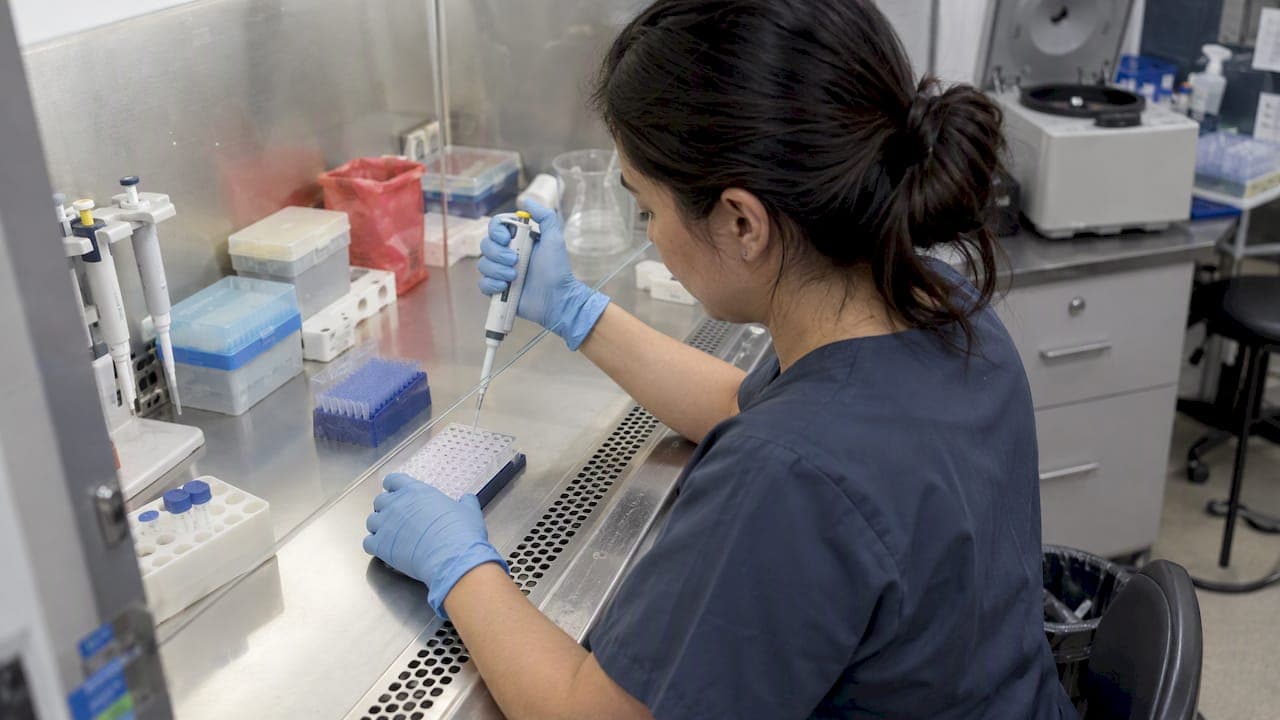
Molecular pathology tests examine the DNA, RNA and proteins in a tissue, cell or fluid sample to find the genetic changes, infectious agents or disease markers behind a diagnosis. Your doctor may order one to confirm a cancer type, choose a targeted therapy, check for an inherited condition or identify an infection. This guide explains the main test types, walks through BRAF mutation testing as a worked example, and covers turnaround times, sample quality and what to ask before you test. It is written for patients and for the clinicians who order these tests.
TL;DR
- Molecular pathology tests look at DNA, RNA and proteins, using methods such as PCR, next-generation sequencing (NGS), FISH and karyotyping.
- Rapid single-gene PCR assays can return answers in about a day. Broad NGS panels typically take 10 to 14 days or more.
- Most delays come from the sample, not the instrument: too little tissue or poor fixation can force a re-biopsy.
- A positive screening result is not a final diagnosis. A diagnostic molecular test confirms it.
- EIV Diagnostics is an independent pathology laboratory in Fresno, CA with board-certified pathologists, and it works with providers, patients with prescriptions and self-pay customers.
Table of Contents
- What molecular pathology tests are
- The main types of molecular diagnostic tests
- BRAF mutation testing: a worked example
- How long molecular results take
- Why the sample matters as much as the machine
- Regulation and accreditation: what makes a result reliable
- Perspective: what we see from the lab side
- Before you test: consent, screening and diagnosis
- Molecular pathology with EIV Diagnostics
- Frequently asked questions
- Sources
What molecular pathology tests are
According to the Association for Molecular Pathology (AMP), molecular pathology is the field that diagnoses and studies disease through the molecules found in organs, tissues, cells and fluids: DNA, RNA and proteins. A traditional pathology report describes what cells look like under a microscope. A molecular report describes what is happening inside them.
The two views work together. In cancer care, molecular testing usually follows a histopathologic diagnosis: a pathologist first identifies the tumor type on the slide, then molecular tests look for the specific alterations that may make a targeted therapy or immunotherapy an option. A review of molecular testing in non-small cell lung cancer describes exactly this sequence, where results identify patients who may benefit from targeted treatment.
The tests are not limited to cancer. AMP notes they are also used to diagnose inherited conditions and infectious diseases, including COVID-19 and HIV.
The main types of molecular diagnostic tests
The methods differ in how much they look at and how fast they run. Choosing between them is a clinical decision based on the question being asked.
| Method | What it does | Typical use |
|---|---|---|
| PCR and real-time PCR | Amplifies a specific stretch of DNA or RNA so it can be detected | Single-gene mutations, infectious agents |
| Next-generation sequencing (NGS) | Reads many genes at once for comprehensive profiling | Tumor panels, hereditary conditions |
| FISH | Uses fluorescent probes to find gene rearrangements or copy changes | Chromosomal abnormalities in tissue |
| Karyotype analysis | Examines chromosomes as a whole | Large chromosomal changes |
| Immunohistochemistry (IHC) | Detects proteins on tissue slides | Protein expression, tumor classification |
The first four rows come straight from AMP’s description of the field. Older overviews, such as this review of diagnostic molecular techniques, list the same core toolkit, which shows how stable the basic methods are even as sequencing has expanded.
Examples you will see in practice
- BRAF V600 testing in melanoma, to see whether a tumor carries an actionable mutation.
- Lung cancer panels, which look for several targetable alterations in the same biopsy.
- Infectious disease PCR, which detects viral or bacterial genetic material.
- Pharmacogenomic (PGx) testing, which looks at inherited gene variants that influence how a person processes certain medicines.
- Inherited disorder testing, which checks for variants that run in families.
BRAF mutation testing: a worked example
BRAF testing is one of the most searched molecular tests, and it shows the trade-offs clearly. The BRAF V600 mutation is found in a share of melanomas, and knowing the status can matter for treatment planning.
In a prospective study of 51 melanoma patients, researchers ran two BRAF V600 assays on the same tissue: an automated real-time PCR system and NGS. The mutation was found in 23 of 51 cases (45%). The two methods agreed 100% of the time. The difference was speed and tissue: the PCR assay had a turnaround time of 0.2 days against 12.2 days for NGS, and it needed less tumor material.
The same study adds an honest caveat. Because most patients in that cohort received immunotherapy first regardless of BRAF status, the faster result changed the treatment decision in few cases. A fast test is not automatically a better test. The right choice depends on the question:
- You only need to know BRAF V600 status. A targeted PCR assay is quick and uses little tissue.
- You need a broader picture. NGS reads many genes in one run, which matters when several alterations could change the plan.
- Tissue is scarce. A small biopsy may not support a wide panel, so the ordering clinician and pathologist should agree on priorities before the sample is cut.
A BRAF mutation assay is a laboratory test on tumor tissue. Interpreting it belongs to your oncologist or dermatologist, who will weigh it with your pathology report, stage and overall health.
How long molecular results take
Turnaround depends on the method and on the sample. In non-small cell lung cancer, the same review reports that basic tests like IHC may return in 1 to 2 days, while advanced profiling such as NGS typically takes 10 to 14 days or longer. The BRAF study above measured 12.2 days for NGS and a fraction of a day for the automated PCR assay.
The time starts earlier than most people think. The review notes that delays often occur when there is not enough tumor tissue, which can mean a re-biopsy, and it cites a recommended standard of sending specimens to external labs within 3 working days of the request. Every day a block sits in a drawer is a day added to the result.
To keep timelines short:
- Ask the lab whether it can run the test on the tissue already collected before scheduling a new biopsy.
- Confirm that the requisition lists the exact test, the clinical question and the specimen location.
- Ship or hand off specimens promptly, with the fixation details documented.
Why the sample matters as much as the machine
Laboratory quality starts before the sample reaches the bench. The pre-analytic phase covers how tissue is collected, fixed (for example in formalin) and transported. A paper on optimizing the tumor tissue journey describes pathologists taking an active role in biopsy planning and in overseeing that journey from collection to final interpretation, so that tissue is used effectively for the patient’s diagnostic and treatment goals.
That is practical, not abstract. Too little tissue or improper fixation can make a test fail, and a failed test can mean a second procedure and a later start to treatment.
What happens inside the lab
Molecular labs also work differently from routine histology labs. Federal CLIA rules require that contamination of patient specimens, reagents and supplies is minimized, and they address how molecular amplification procedures are handled. In practice, labs use a one-way workflow: preparation and extraction, then amplification, then detection. Once material enters the amplification area, it does not go back, because amplified product could contaminate the next run and produce a false result. AMP’s graphic of a clinical molecular laboratory shows the same sequence, from breaking the sample down into DNA, RNA and proteins through to analysis.

Regulation and accreditation: what makes a result reliable
Many molecular tests are laboratory developed tests (LDTs): in vitro diagnostics designed, manufactured and used within a single laboratory that meets CLIA requirements. The FDA issued a final rule in May 2024 changing how these tests are overseen, and a federal court took action on it in March 2025. Because that status has moved, check the FDA page for the current position rather than relying on a summary.
For a patient or ordering clinician, the practical takeaways are stable: ask whether the lab is CLIA-certified, whether it holds College of American Pathologists (CAP) accreditation, and who signs the report. EIV Diagnostics describes its quality standards as CAP-accredited and its reports as signed by board-certified pathologists.
The stakes are real. The FDA has said that inaccurate tests can lead to unnecessary treatment or delay needed care. For a plain-language look at how another health provider explains lab methods and the limits of consumer testing, see this overview of microbiome lab methods.
Perspective: what we see from the lab side
We think the most underrated step in molecular testing is the conversation that happens before the biopsy. Technology gets the attention, but the quality of the answer is capped by the quality of the specimen. When a pathologist is involved early, the sample is more likely to be adequate, fixed correctly and routed to the right test the first time.
We also think molecular results should be read alongside morphology, not in place of it. A mutation finding means the most when the pathologist has seen the slide, the clinical history and the question the physician is asking. That is why we pair molecular pathology with dermatopathology, histopathology and digital pathology under the same roof in Fresno, with board-certified pathologists reviewing the case.
And we believe patients should not be left out. Convenience matters when you are already stressed, which is why we offer mobile phlebotomy and self-pay testing alongside our work for physicians.
— EIV Diagnostics
Before you test: consent, screening and diagnosis
Genetic and molecular results can affect more than one person. AMP’s patient education page on inherited disorders, written by genetics and molecular pathology experts, stresses informed consent before genetic testing: you should understand how the test is done, its potential benefits and its limits. A result can have implications for your relatives as well as for you.
The same resource draws a line between screening and diagnosis. A screening test is built to catch as many possible cases as it can, so it will flag some people who do not have the condition. A positive screen should be followed by a diagnostic molecular test that confirms or rules out the genetic change. Do not make treatment decisions from a screening result alone.

If you are exploring DNA-based services outside the clinic, such as wellness coaching, keep that distinction in mind. One example is a fitness and nutrition coaching provider that uses DNA analysis to personalize its plans. Coaching of that kind is not a medical diagnosis. If a result raises a health concern, take it to your physician, and for a hereditary question, ask for a referral to a genetic counselor.
Questions to ask your doctor or lab
- What exactly is this test looking for, and what will the result change?
- Is the existing biopsy tissue enough, or will I need another sample?
- Is this a screening test or a diagnostic test?
- How long will results take, and who will explain them to me?
- What are the limits of the test, including the chance of a false positive or false negative?
Molecular pathology with EIV Diagnostics
EIV Diagnostics is an independent pathology laboratory at 1477 E. Shaw Avenue, Suite 170, Fresno, CA 93710. Our molecular pathology service supports physicians who need reliable answers, and it sits alongside dermatopathology, digital pathology and clinical pathology. You can see the full list on our services page, including histopathology, cytology, toxicology and pharmacogenomic testing.
We serve Fresno, Clovis, Madera, Visalia, Hanford, Sanger, Reedley and the surrounding Central Valley counties. Providers can send specimens to us. Patients with a prescription can use us as their lab. If you want to order without a doctor’s visit, our self-pay testing option lets you pay directly. And if getting to a draw site is the obstacle, mobile phlebotomy brings the draw to your home or office, starting from $65 per visit.
A self-pay or home draw is suited to blood and fluid-based tests. Whether a tissue-based molecular test is appropriate for you is a question for the physician who performed or will perform your biopsy.
Frequently asked questions
What are molecular pathology tests?
They are laboratory tests that analyze DNA, RNA and proteins in tissue, cells or fluids. Doctors use them to identify genetic mutations, infectious agents and disease markers. Common methods include PCR, NGS, FISH and karyotyping.
Why would a biopsy be sent for molecular testing?
The slide shows what a tumor looks like, but not always which genetic changes drive it. Molecular testing on the same tissue can find alterations, such as BRAF V600, that may point to a targeted therapy or immunotherapy. Your physician decides which tests fit your diagnosis.
How long does molecular testing take?
It depends on the method. A targeted PCR assay for a single gene can return within a day in a lab with the right system, while broad NGS profiling typically takes 10 to 14 days or longer. An inadequate sample can add time if a re-biopsy is needed.
Can I order a molecular test without a doctor?
Some laboratory tests can be bought directly through self-pay options. Tissue-based molecular tests normally depend on a biopsy and a physician’s order, and results need clinical interpretation. If you are unsure which applies to you, call us at (559) 777-7117 or ask your doctor.
Is a positive screening test a diagnosis?
No. Screening tests are designed to catch as many possible cases as they can, so some positives are not real. A diagnostic molecular test is used to confirm the finding before decisions are made.
Sources
- What is molecular pathology? Association for Molecular Pathology
- Molecular testing strategies in non-small cell lung cancer: optimizing the diagnostic journey
- An automated real-time PCR assay versus NGS in the detection of BRAF V600 mutations in melanoma
- Pathologists at the leading edge of optimizing the tumor tissue journey
- CMS CLIA regulations, section 493
- AMP: inside a clinical molecular laboratory
- FDA: Laboratory Developed Tests
- FDA: Final Rule on Laboratory Developed Tests, transcript
- FDA announcement on the safety and effectiveness of laboratory developed tests
- AMP Outreach: Inherited disorders