
By EIV Diagnostics · August 11, 2026
CLIA Certification Explained for U.S. Lab Managers
Discover how CLIA certification impacts U.S. labs. Learn about requirements, application steps, and key resources for managing compliance.

The Clinical Laboratory Improvement Amendments of 1988 (CLIA) require every U.S. facility that tests human specimens for diagnosis, prevention, or treatment to hold a valid federal certificate before accepting a single sample. The regulation lives at 42 CFR Part 493, and three agencies share oversight: the Centers for Medicare & Medicaid Services (CMS) administers the program, the CDC provides technical and educational support, and the FDA categorizes the complexity of each in vitro diagnostic test. Your single most important first step is to identify the highest-complexity test on your menu, then submit Form CMS-116 to your State Agency.
Key immediate resources:
- CMS CLIA program — application, certificate types, and fee guidance
- CDC CLIA overview — enrollment steps and waived-test guidance
- FDA CLIA complexity database — official categorization for every cleared IVD
Key Takeaways
CLIA certification requires identifying your highest-complexity test first, submitting Form CMS-116 to your State Agency, paying fees on pay.gov, and maintaining biennial compliance through PT, QC, and documented personnel qualifications.
| Point | Details |
|---|---|
| Identify test complexity first | Use the FDA CLIA database to confirm every test’s category before choosing a certificate type. |
| Certificates renew every two years | Build renewal tasks into your compliance calendar from the day you receive your certificate. |
| Non-waived labs face biennial surveys | CoC and CoA labs must maintain PT, QC logs, SOPs, and personnel files at all times. |
| Use a shared business email | Fee coupons and renewal notices arrive electronically; a personal email creates lapse risk. |
| Modifications default to high complexity | Any change to manufacturer instructions requires a full high-complexity compliance plan. |
This article is general information, not a substitute for advice from a qualified doctor. Consult a qualified healthcare professional about your own circumstances before acting on anything here.
Table of Contents
- Why CLIA matters for patient safety and lab quality
- Which facilities need a CLIA certificate, and when are exceptions allowed?
- Test complexity categories: what waived, moderate, and high mean for your lab
- CLIA certificate types and which one fits your lab
- How to apply for CLIA certification step by step
- Surveys, proficiency testing, and maintaining ongoing compliance
- Consequences of noncompliance and common survey deficiencies
- How to determine test complexity when adding new tests
- State programs, multi-site rules, and special cases
- Practical guidance for lab managers: avoiding the most common pitfalls
- EIV Diagnostics and CLIA-compliant pathology services
- Sources
- FAQ
Why CLIA matters for patient safety and lab quality
CLIA exists for one reason: patients make treatment decisions based on lab results. An incorrect glucose reading can drive a dangerous insulin dose. A missed pathogen on a culture can delay life-saving antibiotics. The program’s goal, as CMS and CDC frame it, is to ensure that every test result is accurate, reliable, and delivered on time regardless of where testing occurs.
The statutory and regulatory backbone is the Clinical Laboratory Improvement Amendments of 1988, implemented through 42 CFR Part 493. CMS holds primary enforcement authority, CDC supports quality improvement and technical assistance, and FDA determines complexity categorization for cleared IVDs. All three agencies publish guidance that labs should treat as primary sources, not optional reading.
CLIA certificates are valid for a limited period, after which labs must renew to stay operational.
The practical outcomes the regulatory framework drives:
- Reduced diagnostic errors through mandatory quality control and proficiency testing
- Accountability for personnel qualifications matched to test complexity
- Routine survey oversight for non-waived labs, creating a documented compliance cycle
- Defined corrective action pathways when deficiencies appear
Which facilities need a CLIA certificate, and when are exceptions allowed?
Under CLIA, a “laboratory” is any facility that examines materials derived from the human body to provide information for diagnosis, prevention, or treatment of disease. That definition is deliberately broad. A physician office lab running a fingerstick glucose test qualifies. So does a hospital core lab, a reference lab, a mobile phlebotomy service that processes specimens on-site, and a direct-to-consumer testing company. CDC confirms that labs must enroll before accepting human specimens for clinical testing.
Common exceptions where CLIA does not apply:
- Forensic testing (not used for patient diagnosis or treatment)
- Research testing that does not report patient-specific results back to providers or patients
- SAMHSA-certified workplace drug testing programs (limited exemption; clinical drug testing for patient care still requires CLIA)
- Facilities in states with approved exempt programs (New York and Washington operate their own equivalent programs; see Section 10)
Pro Tip: Edge cases are common. A research lab that occasionally shares results with a treating clinician may cross into CLIA territory without realizing it. Contact your State Agency before assuming an exemption applies — the cost of a phone call is far lower than the cost of operating without a certificate.
Test complexity categories: what waived, moderate, and high mean for your lab
The FDA categorizes every cleared IVD under criteria in 42 CFR 493.17. The category assigned to your highest-complexity test determines your certificate type and your entire compliance burden.
The three categories
-
Waived tests are cleared as simple, low-risk, and designed for minimal training. Examples include most point-of-care glucose meters and rapid influenza tests. Labs performing only waived tests need a Certificate of Waiver (CoW) and must follow manufacturer instructions exactly. Waived does not mean unregulated: CDC cautions that improper performance of waived tests can cause serious patient harm.
-
Moderate complexity tests cover the majority of routine clinical laboratory testing, including most automated chemistry analyzers and standard hematology platforms. These require documented personnel qualifications, quality control, proficiency testing (PT), and biennial on-site surveys.
-
High complexity tests include most molecular assays, cytogenetics, histopathology, and any test that requires substantial scientific judgment. Requirements are the most stringent: doctoral-level or equivalent laboratory director qualifications, detailed QC, PT, and biennial surveys.
How to verify a test’s complexity
Use the FDA CLIA database to look up every test on your menu by product name or 510(k) number. Check the package insert as a secondary confirmation.
Critical warning: If you modify a manufacturer’s instructions — change the specimen type, alter the reagent concentration, or use the test for an indication not in the labeling — that test defaults to high complexity under FDA rules. Plan for high-complexity personnel, QC, and PT requirements before making any modification.
CLIA certificate types and which one fits your lab
CMS defines five certificate types, each tied to the complexity of testing performed and the path to ongoing oversight.
| Certificate Type | Who It Applies To | Routine Survey Schedule | Core Requirements |
|---|---|---|---|
| Certificate of Waiver (CoW) | Labs performing only waived tests | No routine survey; complaint-driven | Follow manufacturer instructions; no PT required |
| PPM Certificate | Labs performing only provider-performed microscopy | No routine survey | Limited to specific microscopy procedures by a qualified provider |
| Certificate of Registration (CoR) | Labs applying for CoC or CoA awaiting initial survey | Temporary; survey scheduled after issuance | Interim authorization to operate non-waived testing |
| Certificate of Compliance (CoC) | Non-waived labs surveyed by State Agency | Biennial on-site survey | PT, QC, personnel qualifications, SOPs |
| Certificate of Accreditation (CoA) | Non-waived labs accredited by a CMS-approved organization | Biennial accreditation survey | Same as CoC; accreditor conducts survey |
All certificates have a limited validity period. The CoR is temporary — it authorizes operation while CMS schedules the initial compliance survey.
CMS-approved accreditation organizations for CoA include the College of American Pathologists (CAP), The Joint Commission, AABB, A2LA, ACHC, COLA, and ASHI. Each has its own application process and fee structure layered on top of the CLIA fee.
Documents commonly required when applying for a CoC or CoA:
- Laboratory director credentials (degree, training, and board certification documentation)
- Evaluated equivalencies for any foreign credentials
- Evidence of accreditation (CoA applicants)
- Completed Form CMS-116 with all sections applicable to non-waived testing
How to apply for CLIA certification step by step
The CMS Quick Start Guide walks through the full enrollment sequence. Here is the practical order:
- Determine your highest-complexity test. This sets your certificate type before you touch the form.
- Gather required documents. For non-waived testing, that means laboratory director credentials, any foreign credential evaluations, and your lab’s physical address and ownership information.
- Complete Form CMS-116. Download it from CMS or use a state-hosted version. Fill in all sections that apply to your certificate type. A state quick-start guide can help you navigate common form fields and avoid errors.
- Submit to your State Agency. CMS routes CLIA applications through State Survey Agencies, not directly. Find your state contact on the CMS CLIA page.
- Receive your fee coupon. CMS sends a fee coupon to the email address on file after processing your application.
- Pay on pay.gov. Use the fee coupon to complete payment through pay.gov. Fees vary by certificate type and test volume.
- Receive your CLIA ID and certificate. CMS issues a 10-character CLIA ID and sends the certificate electronically. CMS has moved to a fully paperless system, so a valid business email is not optional.
For non-waived labs receiving a CoR, expect the initial compliance survey within the first year of operation. Treat that first year as the most scrutinized phase of your CLIA lifecycle.
Pro Tip: Use a shared, monitored business email address — not a personal one — for all CLIA correspondence. Fee coupons and renewal notices arrive electronically, and a missed email can cause an inadvertent lapse in certification.
Surveys, proficiency testing, and maintaining ongoing compliance
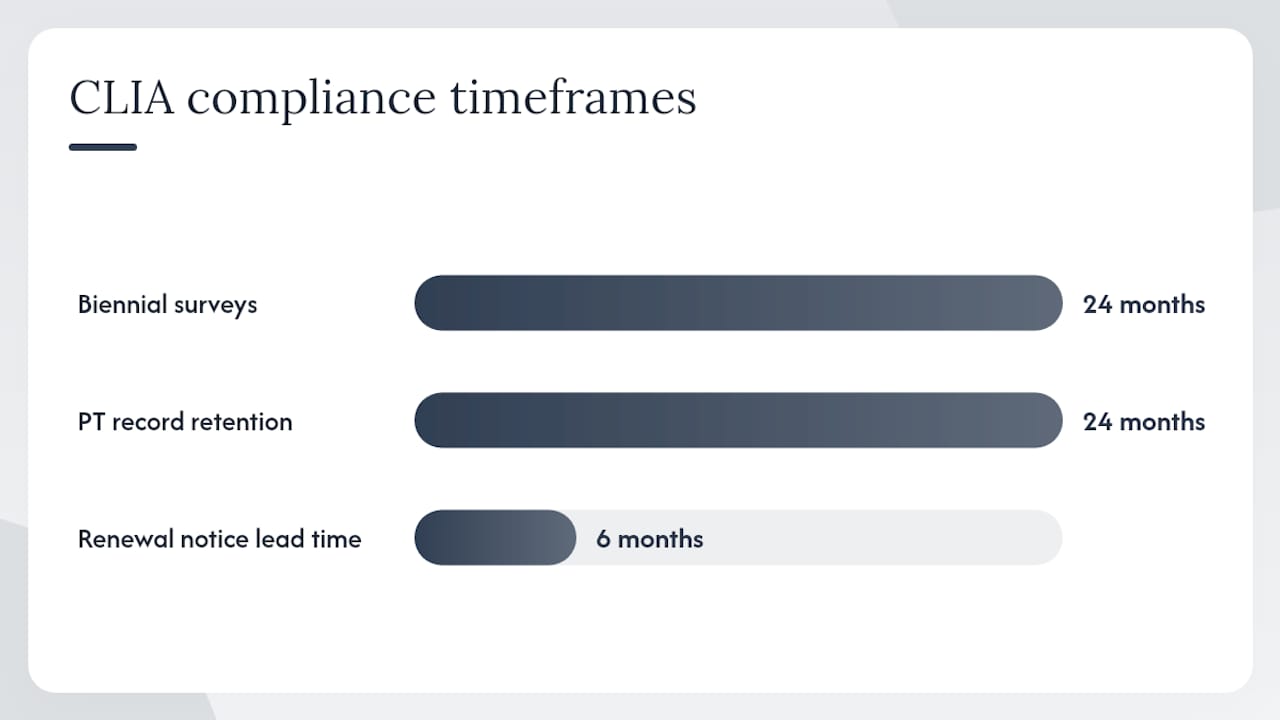
Routine survey schedules depend on your certificate type. CoC and CoA labs face biennial on-site surveys. CoW and PPM labs are not routinely surveyed but can be inspected following a complaint or quality concern.
Proficiency testing obligations for non-waived labs:
- Enroll in a CMS-approved PT program for each regulated analyte you test
- Test PT samples using the same process as patient samples — no special handling
- Submit PT results on time; late or failed submissions trigger immediate review
- Document corrective actions for any PT failure before the next testing event
CDC confirms that non-waived tests require PT, QC, personnel qualifications, and biennial surveys as a package — you cannot opt out of one element while maintaining the others.
Survey readiness checklist:
- Personnel files with current qualifications and competency assessments
- QC logs for all regulated analytes, current and archived
- PT enrollment records and result reports for the past two years
- Standard operating procedures (SOPs) for every test performed
- Corrective action records tied to specific QC failures or PT events
- Equipment maintenance and calibration logs
Renewal invoices typically arrive roughly six months before certificate expiration for some certificate types. Mark the expiration date on your lab calendar the day you receive your certificate and build a renewal task into your compliance calendar.
Consequences of noncompliance and common survey deficiencies
CMS enforcement authority includes a range of sanctions calibrated to the severity and duration of a deficiency. At the lower end, labs receive a directed plan of correction and increased monitoring. More serious violations can result in suspension of Medicare payments, limitation of testing scope, civil monetary penalties, or full revocation of the CLIA certificate.
Most common deficiencies cited during surveys:
- Missing or inadequate laboratory director qualifications for the certificate type held
- Insufficient PT participation (wrong analytes enrolled, late submissions, or no corrective action documented)
- Inadequate QC frequency or documentation gaps
- Testing outside the scope of the certificate (e.g., performing high-complexity tests under a CoW)
- Poor or absent documentation of personnel competency assessments
Immediate remediation steps after a citation or PT failure:
- Acknowledge the deficiency in writing to the surveyor or PT program within the required timeframe
- Identify root cause — equipment, personnel, process, or reagent
- Implement corrective action and document every step
- Re-test or re-assess the affected process before resuming routine patient testing
- Submit the plan of correction to CMS or your State Agency by the deadline stated in the citation
How to determine test complexity when adding new tests
Before a new test goes live, verify its regulatory status. The FDA CLIA database is the authoritative source — not the sales rep’s brochure and not a competitor’s website.
Procurement and validation checklist for new tests:
- Search the FDA CLIA database for the specific product name and lot configuration you plan to use
- Review the package insert for the exact specimen type, instrument, and reagent combination you will run
- Confirm whether your current certificate covers the complexity level of the new test
- If planning any modification to the manufacturer’s instructions, treat the test as high complexity from day one and adjust personnel, QC, and PT enrollment accordingly
- Obtain written validation documentation from the vendor: analytical sensitivity, specificity, precision, and reference range data
- Complete your own verification study (accuracy, precision, reportable range) before clinical use
- Update your SOP binder and personnel training records before the first patient sample runs
Pro Tip: Engage your vendor’s regulatory affairs team early — before purchase, not after installation. Ask specifically whether the configuration you plan to run matches the cleared indication. A mismatch discovered post-installation means a high-complexity reclassification and potential personnel changes.
For labs running molecular diagnostic tests, this step is especially consequential: PCR-based assays are almost always high complexity, and any in-house modification to primers or targets requires a full high-complexity compliance plan.

State programs, multi-site rules, and special cases
New York and Washington operate state laboratory programs that CMS has approved as equivalent to CLIA. Labs in those states apply to the state program rather than directly to CMS for federal CLIA certification. New York’s Clinical Laboratory Evaluation Program (CLEP) and Washington’s Department of Health Laboratory Quality Assurance program each have their own forms, fees, and inspection cycles. Holding a valid state certificate in NY or WA satisfies the federal CLIA requirement.
Multi-site and mobile testing rules:
- Each fixed laboratory site generally requires its own CLIA certificate
- Mobile testing units (health fairs, community screening events) may qualify for a certificate exception if testing is limited in scope and performed under the oversight of a certified laboratory
- Public health programs conducting limited waived testing at multiple community sites sometimes operate under a single certificate with documented satellite site controls — confirm with your State Agency before assuming this applies
International labs: If a laboratory outside the U.S. seeks CLIA certification to serve U.S. patients or providers, CMS designates a specific international contact. The CMS CLIA application page lists that contact and the modified documentation requirements for international applicants.
Practical guidance for lab managers: avoiding the most common pitfalls
The administrative side of CLIA trips up experienced lab managers as often as the technical side. Most delays and deficiencies are preventable.
Before you submit CMS-116:
- Compile laboratory director credentials in a single folder: degree transcripts, board certification certificates, and any foreign credential evaluation letters from a NACES-approved evaluator
- Confirm the physical address on the form matches the address where testing will occur — a mismatch delays processing
- Choose the correct certificate type based on your highest-complexity test, not your most common test
Survey readiness SOP checklist:
- Staff training logs with dates, trainer names, and competency assessment results
- PT results for the past two years with corrective action documentation for any failures
- QC logs with reference ranges, acceptable limits, and out-of-range corrective actions
- Equipment calibration and preventive maintenance records
- SOPs reviewed and signed within the past year
Avoidable administrative problems:
- Using a personal email for CLIA registration: renewal invoices and fee coupons arrive electronically, and a departed employee’s inbox means a missed renewal
- Failing to notify CMS of ownership changes, director changes, or address changes within the required timeframe — these trigger a new application or amendment, not just a phone call
- Assuming a CoW covers all point-of-care tests: some POC platforms carry moderate complexity ratings and require a different certificate
The CMS CLIA program page lists the specific notification requirements for changes that affect your certificate.
EIV Diagnostics and CLIA-compliant pathology services
EIV Diagnostics operates as a CLIA-certified independent pathology laboratory in Fresno, CA, maintaining the quality systems, personnel qualifications, and proficiency testing programs that federal certification requires. For providers seeking a diagnostic partner that handles the compliance infrastructure — from accessioning through final report — EIV Diagnostics offers clinical pathology services, molecular pathology, and mobile phlebotomy for patients who need lab draws at home or in the office.
Board-certified pathologists review results, and the lab supports both provider-ordered and direct-to-consumer testing. If you are navigating CLIA enrollment and want to understand how a certified reference lab fits into your testing workflow, the For Providers page outlines available services and accessioning options.
Sources
- How to Apply for a CLIA Certificate, Including International Laboratories | CMS
- FDA — Clinical Laboratory Improvement Amendments (CLIA)
- CLIA Certification Quick Start Guide (CMS media)
- CDC — CLIA
FAQ
What does it mean to be a CLIA-certified lab?
A CLIA-certified lab holds a valid federal certificate issued by CMS confirming it meets the quality, personnel, and testing standards required under 42 CFR Part 493. Certification is required before the lab can accept human specimens for clinical testing.
What are the three CLIA test complexity categories?
CLIA recognizes waived, moderate complexity, and high complexity tests. The FDA assigns each cleared IVD to one of these categories; the highest category on your test menu determines your certificate type and compliance obligations.
How long is a CLIA certificate valid?
CLIA certificates are generally valid for two years, after which the lab must renew. CMS sends renewal invoices electronically, so maintaining a current business email on file is necessary to avoid missing the notice.
What are the current CLIA requirements for non-waived labs?
Non-waived labs must enroll in a CMS-approved proficiency testing program, maintain documented quality control, meet personnel qualification standards matched to test complexity, and pass biennial on-site surveys conducted by a State Agency or CMS-approved accreditation organization.
What happens if a lab fails a CLIA survey?
CMS can impose a range of sanctions depending on severity, including directed plans of correction, civil monetary penalties, suspension of Medicare payments, or revocation of the CLIA certificate. Labs must submit a written plan of correction by the deadline stated in the citation.
Recommended
- Clinical Pathology Labs: What Patients Need to Know | EIV Diagnostics | EIV Diagnostics
- Direct Access Lab Testing: Order Your Own Labs Today | EIV Diagnostics | EIV Diagnostics
- Top 4 Affordable Lab Testing Providers 2026 | EIV Diagnostics | EIV Diagnostics
- Top 5 Labcorp Review Diagnostic Providers 2026 | EIV Diagnostics | EIV Diagnostics