
By EIV Diagnostics · September 8, 2026
Trainees, Credentialers & Patients: Verify a Board Certified Pathologist
Practical explainer for trainees, credentialers, and patients on what board certification proves and how to verify it (free ABMS lookup or $35 ABPath record).

A board-certified pathologist has completed accredited medical training, finished an accredited pathology residency, and passed the American Board of Pathology’s certification exams. That designation is verifiable for free through ABMS Certification Matters or through official ABPath primary-source verification. It confirms competence at the time of testing, not a permanent guarantee, which is why continuing certification matters just as much as the initial exam.
TL;DR:
- Most pathologists spend at least 11 to 13 years in training before achieving certification, with optional subspecialty training adding extra years.
- Active continuing certification is required for certificates issued after 2006, and it involves ongoing assessments beyond passing the initial exam.
- Verification of a pathologist’s certification can be done quickly through ABMS Certification Matters or officially via ABPath’s primary-source records for a fee.
- Subspecialty certifications, such as dermatopathology or molecular genetic pathology, require additional fellowship training but do not replace general certification.
- Credentials that are older than 2006 may not include ongoing certification requirements, so check the certificate date before assuming current certification status.
Table of Contents
- What Board Certification Actually Signifies
- Who Governs Pathology Certification
- How to Become Board Certified in Pathology
- Subspecialty Certification and What It Adds
- Continuing Certification and Certificate Expiration
- How to Verify a Pathologist’s Board Certification
- Timelines, Exam Logistics, and Fees to Expect
- What This Means for Patients, Clinicians, and Credentialers
- How Board-Certified Pathologists Shape Work at EIV Diagnostics
- Common Challenges in Maintaining Certification
- Where Pathology Certification Standards Are Heading
- Why Board Certification Deserves More Scrutiny, Not Less
- Get Care Backed by Board-Certified Pathology Expertise
- Sources
- FAQ
What Board Certification Actually Signifies
Passing the exam earns a physician the title “Diplomate of the American Board of Pathology,” a designation with specific ethical boundaries. A pathologist cannot claim board certification in a subspecialty they never sat an exam for, and using the Diplomate title outside its scope is considered a misrepresentation of credentials.
Certification is a snapshot, not a lifetime pass. It proves a pathologist demonstrated the required knowledge, judgment, and technical skill on the day they tested. Staying current after that requires ongoing participation in continuing certification (CC), which functions differently than the one-time licensing exam every physician takes.
A few distinctions worth keeping straight:
- Primary certification covers general anatomic pathology (AP) and/or clinical pathology (CP), the foundation every board-certified pathologist holds.
- Subspecialty certification is additional and optional, layered on top of primary certification, not a replacement for it.
- Diplomate status is the formal term for someone who holds an active ABPath certificate.
- Time-limited certificates (issued in 2006 or later) require CC participation; older certificates do not expire the same way.
Who Governs Pathology Certification
Two organizations sit behind every certification claim a pathologist makes. The American Board of Pathology issues both primary and subspecialty certificates after candidates complete accredited training and pass rigorous exams. The American Board of Medical Specialties oversees ABPath as one of its 24 member boards and runs the Certification Matters database that hospitals, insurers, and patients used to confirm status.
- ABPath sets training prerequisites, administers exams, and issues certificates in pathology and its recognized subspecialties.
- ABMS aggregates certification data from all its member boards into one searchable public tool.
- Hospital credentialing offices and insurance panels treat both as primary sources, meaning they carry more weight than a résumé claim or a state license alone.
How to Become Board Certified in Pathology
Becoming board certified is a sequential process with no shortcuts, and each step gates the next.
- Earn an MD or DO degree. This follows a standard premedical and medical school path, typically four years after a bachelor’s degree.
- Complete an ACGME-accredited pathology residency. Most candidates pursue combined AP/CP training, though AP-only or CP-only tracks exist. Canadian candidates train through RCPSC-accredited programs instead.
- Meet ABPath’s specific prerequisites, which vary depending on whether a candidate is pursuing primary certification alone or planning to add a subspecialty later.
- Apply for board-eligible status. This is a temporary designation granted once ABPath approves an application, and it is not the same thing as being certified. A board-eligible pathologist can practice but has not yet passed the exam that confirms certification.
- Sit for and pass the ABPath certification exam. Only after this step does a pathologist become a Diplomate.
Pro Tip: If you’re evaluating a job candidate or a new hire’s credentials, “board-eligible” and “board-certified” are not interchangeable. Ask directly which status applies, then confirm it through ABPath verification rather than taking a résumé line at face value.
Residency itself typically runs several years depending on the AP/CP combination chosen, and that clock only starts after medical school is finished.
Subspecialty Certification and What It Adds
General certification in AP and/or CP covers the bulk of diagnostic pathology work. Subspecialty certification narrows the focus and usually requires a dedicated fellowship on top of residency.
Common subspecialties include:
- Dermatopathology, focused on skin disease diagnosis, often pursued through a joint pathway with dermatology.
- Cytopathology, centered on cellular sample analysis such as Pap smears and fine-needle aspirations.
- Hematopathology, covering blood and bone marrow disorders.
- Molecular genetic pathology, a cooperative certification ABPath administers jointly with other member boards.
- Neuropathology and pediatric pathology, each requiring additional fellowship training beyond core residency.
A subspecialty credential does not replace general certification; it often involves expertise described in the role of medical forensics in investigations. It complements it, and many pathologists spend most of their careers doing broad diagnostic work while maintaining a subspecialty focus for a portion of their caseload.
Continuing Certification and Certificate Expiration
Certificates issued on or after January 1, 2006, are time-limited and require active participation in ABPath’s continuing certification program. Certificates issued before that date are non-time-limited, meaning some diplomates practicing today will never show up as “actively participating in CC” simply because their certificate predates the requirement.
- CC participation involves ongoing assessment activities designed to demonstrate current knowledge, not a one-time repeat exam.
- Credentialing staff should check the certificate’s issue date before assuming a lack of CC activity signals a problem.
- ABPath’s own guidance to credentialing administrators recommends annual re-verification as a standard practice, precisely because status can change year to year.
The distinction matters more than most credentialing offices realize. A hospital that flags a veteran pathologist for “non-participation” without checking whether their certificate predates 2006 risks an unnecessary and avoidable dispute.
How to Verify a Pathologist’s Board Certification
Verification takes minutes, not weeks, and there are two tiers depending on how much documentation you need.
- Search ABMS Certification Matters first. It’s free, refreshed daily across all 24 ABMS member boards, and sufficient for most patients or quick provider checks.
- Request ABPath primary-source verification if you need official documentation for credentialing files. This currently carries a $35 processing fee and produces a formal record accepted by hospitals and payers.
- Collect the right identifiers before searching, including the pathologist’s full legal name, specialty or subspecialty, NPI number, and approximate year of certification.
Credentialing teams that skip primary-source verification in favor of a public lookup alone sometimes miss subspecialty distinctions that only show up in the official record.
Timelines, Exam Logistics, and Fees to Expect
The path from undergraduate student to independently practicing pathologist typically runs 11 to 13 years: four years of college, four years of medical school, three to four years of residency, and, for many pathologists, one to two additional years of fellowship for subspecialty training.
- ABPath administers primary certification exams during scheduled windows, generally in spring and fall, through Pearson testing centers.
- Exam scheduling and preparation resources are detailed in ABPath’s Booklet of Information, which candidates should review well before applying.
- Primary-source verification costs $35 per request as of this writing; current exam fees change periodically, so checking ABPath’s site directly before applying is the safer move.
What This Means for Patients, Clinicians, and Credentialers
A board-certified pathologist reading a biopsy or interpreting a molecular panel has cleared a bar that a license alone doesn’t guarantee. Certification adds a layer of confidence for referring clinicians choosing where to send difficult cases, and for patients who want to know a diagnosis carries real scrutiny behind it.
- Subspecialty certification signals deeper expertise in a narrow area, useful when a case involves something like an unusual skin lesion or a rare hematologic finding.
- Lab accreditation and individual pathologist certification are separate but related: a well-credentialed lab staffed by board-certified pathologists offers more assurance than either fact alone.
- If verification raises a question, ask the provider directly, then request primary-source verification through ABPath rather than relying on secondhand claims.
Pro Tip: Patients reviewing a pathology report rarely see the pathologist’s name prominently, but it’s usually listed on the report itself. That name is exactly what you plug into Certification Matters if you want a second layer of confidence.
How Board-Certified Pathologists Shape Work at EIV Diagnostics
EIV Diagnostics employs board-certified pathologists across its diagnostic services, including molecular pathology, dermatopathology, digital pathology, and clinical pathology, alongside mobile phlebotomy for patients who need testing without a lab visit.
- Certified professional oversight supports accurate, defensible diagnoses across molecular, dermatopathology, and digital pathology workflows.
- Mobile phlebotomy extends access without changing who ultimately reads and signs off on results.
- Rapid turnaround depends on having qualified pathologists available to review cases without unnecessary bottlenecks.
Referring providers can review specifics on the provider-facing services page for how staffing translates into reporting speed and diagnostic consistency.
Common Challenges in Maintaining Certification
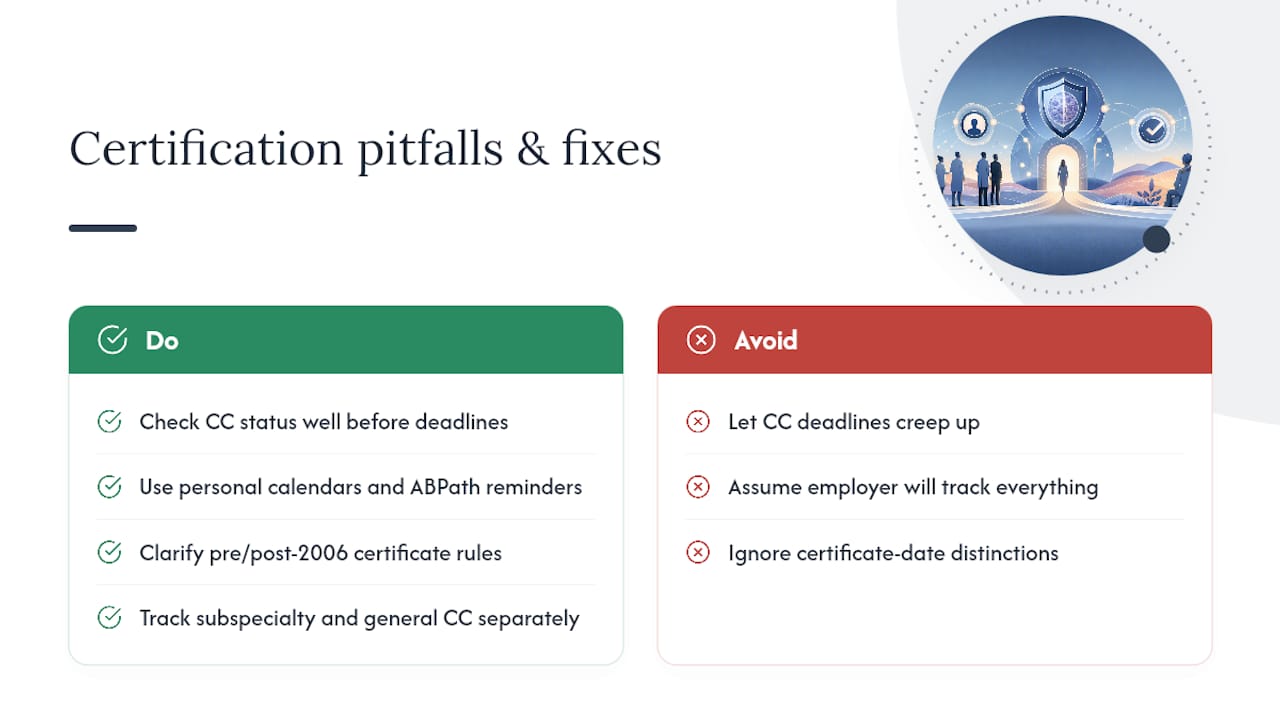
Staying certified is not a passive status. Continuing certification requires pathologists to document ongoing learning and assessment activity, and that takes time away from an already demanding caseload. Busy practitioners sometimes let CC deadlines creep up on them, particularly in smaller labs where administrative support is thin.
Subspecialty maintenance adds another layer. A pathologist holding both general and subspecialty certification may face separate CC obligations for each, effectively doubling the tracking burden. Fellowship-trained dermatopathologists or hematopathologists often describe this as the least glamorous part of an otherwise rewarding career path.
Certificate-date confusion creates friction on the credentialing side too. A hospital compliance officer unfamiliar with the pre/post 2006 distinction may flag a veteran, fully compliant pathologist as delinquent simply because their certificate never required CC participation in the first place. That kind of false alarm wastes time for everyone and occasionally damages a pathologist’s standing during a credentialing review.
Rural and independent labs face a different version of the same problem: fewer colleagues to share CC-related administrative work with, and less institutional bandwidth to track renewal windows. Pathologists in these settings tend to rely more heavily on personal calendars and reminders from ABPath rather than an employer’s credentialing office. Building a habit of checking status well ahead of any deadline, rather than reacting to a notice, remains the most reliable safeguard against a lapse.
Where Pathology Certification Standards Are Heading
Continuing certification models across ABMS member boards have shifted over the past decade from periodic high-stakes recertification exams toward more frequent, lower-stakes longitudinal assessment. Pathology has followed that broader trend, with CC activities designed to feel less like a single make-or-break test and more like an ongoing professional habit.
Digital and molecular pathology are also reshaping what subspecialty training looks like in practice. As diagnostic work increasingly involves digital slide review and molecular panels, fellowship programs have adjusted curricula to include these tools earlier, even though ABPath’s certification structure itself has stayed anchored to established subspecialties like molecular genetic pathology rather than creating new categories overnight.
Credentialing practices are tightening too. ABMS’s emphasis on daily-refreshed verification data reflects growing pressure from hospitals and insurers to catch status changes quickly, rather than relying on annual snapshots. That pressure trickles down to individual pathologists, who increasingly need to treat CC participation as a continuous obligation rather than something to address only when a credentialing office asks.
None of this changes the core structure that trainees have followed for years: accredited residency, board eligibility, exam, certification, and ongoing CC. What’s changing is the tooling around it and the frequency of scrutiny, not the fundamental bar candidates have to clear.
Why Board Certification Deserves More Scrutiny, Not Less
The conventional advice on this topic stops at “check if they’re board certified” as if that’s a single yes-or-no gate. It isn’t. The more useful judgment is checking when they were certified, whether their certificate predates the 2006 CC requirement, and whether any subspecialty claims match what ABPath actually lists. Skipping that nuance is how credentialing offices end up flagging compliant pathologists or, worse, missing a lapsed subspecialty claim entirely.
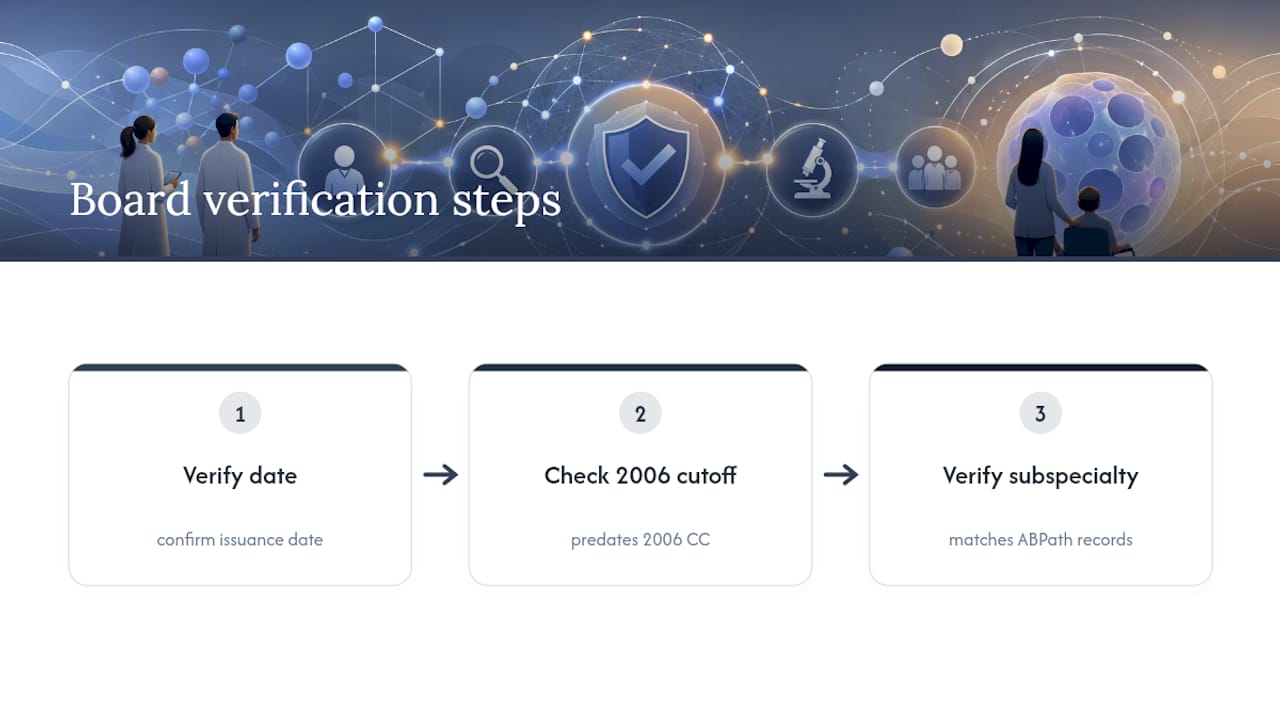
What’s overrated is treating board certification as a permanent stamp of quality. It’s a strong signal, not a guarantee, and the entire CC framework exists because ABMS and ABPath both recognize that medicine changes faster than a single exam can capture. What’s underrated is how much friction primary-source verification removes from disputes before they start. A $35 verification request is cheap insurance compared to the cost of a credentialing error surfacing during an audit or, worse, a malpractice review.
If there’s one priority for trainees, patients, and credentialing staff alike, it’s this: verify directly, verify the dates, and never treat “board-eligible” as a synonym for certified.
— EIV Diagnostics
Get Care Backed by Board-Certified Pathology Expertise
EIV Diagnostics is built around the same credential standard this article just walked through: every diagnosis leaving the lab passes through board-certified pathologists, whether the case involves a routine clinical pathology panel, a complex molecular pathology workup, or a dermatopathology read.
What sets this laboratory apart for readers coming from this explainer is straightforward: you don’t have to choose between fast results and credentialed oversight. Mobile phlebotomy brings the blood draw to your home or office, while certified pathologists handle the diagnostic work behind the scenes, whether you’re a patient paying directly, arriving with a provider’s order, or a clinician who needs a dependable lab partner. If you want a diagnostic workup you can verify and trust, start by exploring EIV Diagnostics’ molecular pathology services or reach out to arrange a mobile phlebotomy visit near you.
This article is general information, not a substitute for advice from a qualified doctor. Consult a qualified healthcare professional about your own circumstances before acting on anything here.
Sources
- About Certification - American Board of Pathology
- Verify Certification - American Board of Pathology
- Verify Certification | American Board of Medical Specialties (ABMS)
- Requirements for Certification - American Board of Pathology
FAQ
What is a board-certified pathologist?
A board-certified pathologist is a physician who completed accredited pathology training and passed the American Board of Pathology’s certification exams, verifiable through ABMS Certification Matters or ABPath primary-source verification.
How many years does it take to become a pathologist?
Most pathologists spend roughly 11 to 13 years total: four years of college, four years of medical school, three to four years of residency, and often one to two additional years of fellowship for subspecialty training.
What certifications do you need to be a pathologist?
At minimum, a pathologist needs primary board certification from ABPath in anatomic pathology, clinical pathology, or both; subspecialty certifications like dermatopathology or molecular genetic pathology are optional additions requiring further fellowship training.
What is board-eligible versus board-certified?
Board-eligible is a temporary status granted after ABPath approves an application to sit for the exam; board-certified means the pathologist has actually passed that exam, and the two terms are not interchangeable.
How do I check if a pathologist is actually board certified?
Search ABMS Certification Matters for a free lookup, or request official ABPath primary-source verification for a $35 processing fee if you need documentation for credentialing files.