
By EIV Diagnostics · September 17, 2026
Chain of Custody Explained: 7 Steps Clinicians and Patients Must Know
Protect patient identity and avoid rejected lab results with seven practical custody checks clinicians and patients can use.
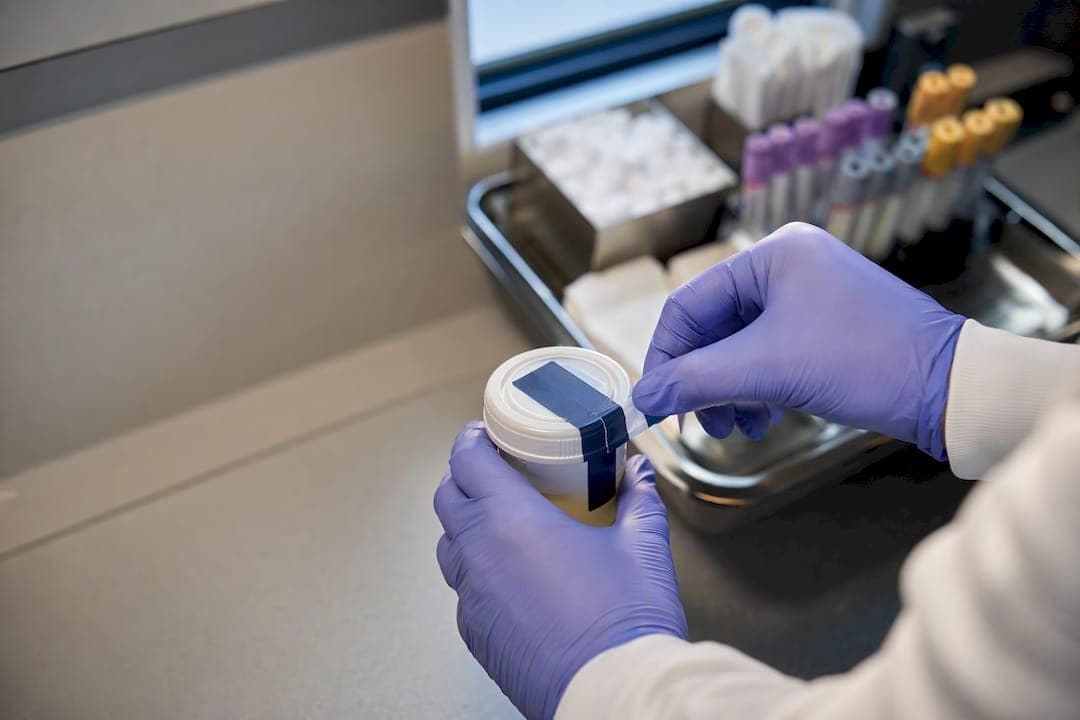
Chain of custody for a clinical specimen is the documented process that proves who collected it, how it was labeled, and what happened to it between the patient and the pathologist’s bench. Its purpose is narrow but critical: preserve specimen identity, integrity, and traceability so the final result can be attributed to the right patient with confidence. Break any link in that chain and the result becomes unreliable, no matter how accurate the lab’s instrument is.
TL;DR:
- Chain of custody procedures are only necessary for legal, employment, or irreplaceable specimens; routine clinical tests rely on barcode tracking within the LIS.
- Accurate, immediate labeling with two identifiers and documented transfers at each step are critical to prevent misattribution and specimen rejection.
- Common errors include labeling shortcuts, broken seals, incomplete documentation, transport batching, and manual workflows that increase the risk of specimen mishandling.
- Breaks in custody are considered serious and can lead to specimen rejection or flagged results; immediate documentation and recollection are required.
- Each party, from collectors to couriers to laboratories, bears responsibility for maintaining specimen integrity and should follow strict procedures to ensure custody is preserved.
Table of Contents
- Understanding Chain of Custody: When Formal Controls Kick In
- The Chain-of-Custody Process, Step by Step
- Common Chain-of-Custody Errors and How to Prevent Them
- What Happens When the Chain of Custody Breaks
- Who’s Responsible: Collectors, Couriers, Labs, and Patients
- Regulatory Standards Behind Specimen Custody
- How EIV Diagnostics Approaches Custody Integrity
- What This Means for Your Next Lab Order
- The Gap Between Policy and Practice
- Sources
- FAQ
Understanding Chain of Custody: When Formal Controls Kick In
Not every blood draw needs a signed custody form. Routine clinical orders, like a basic metabolic panel or a lipid check, rely on standard barcode tracking through the laboratory information system (LIS). That’s sufficient for most care.
Formal chain-of-custody procedures apply in specific situations:
- Employment or pre-placement drug and alcohol testing
- Legal or regulatory testing where results may be challenged in court or an administrative hearing
- Certain paternity, custody, or fertility-related specimens where identity disputes are foreseeable
- Irreplaceable specimens, such as a single biopsy core or a limited cerebrospinal fluid sample, where recollection isn’t realistic even in routine clinical care
Before ordering, clinicians and patients should confirm three things: does this test require a custody kit, does collection need a witness, and are there special transport or temperature requirements. A five-minute check at the front end avoids a rejected result two days later.
The Chain-of-Custody Process, Step by Step
A clinical specimen moves through a defined sequence from the moment a phlebotomist walks in the room to the moment the lab logs it into the system. Skipping a step anywhere in that sequence is how misattribution happens.
- Verify identity. Confirm at least two identifiers, typically full name and date of birth, and check government-issued ID when the test requires it.
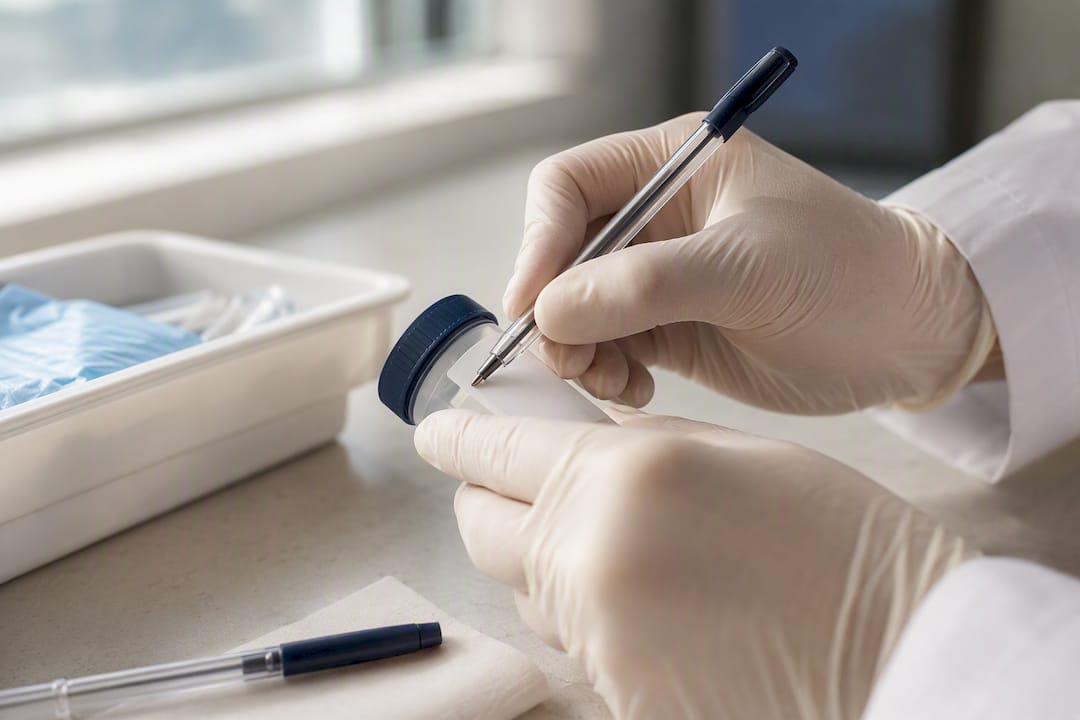
- Label immediately. Apply the label to the container body, not just the lid, while the patient is still present. CLSI PRE01 sets the consensus standard for this identification process across collection, transport, and receipt.
- Complete the custody form or matching LIS order. Record the specimen ID number, collector’s name, and exact date and time. Add witness signatures when the protocol calls for one.
- Apply a tamper-evident seal. Have the donor or collector initial across the seal where required, so any later tampering is visually obvious.
- Package for transport under documented conditions. Note temperature requirements and packaging type on the form itself.
- Track every handoff. Each transfer, courier to lab, lab to reference facility, gets a signature, date, and time. No handoff should go unrecorded.
- Receive and accession at the laboratory. Staff log the exact date and time of receipt, accession the specimen into the LIS, and route it to testing or storage.
Federal regulation backs this sequence directly. 42 CFR §493.1242 requires laboratories to maintain written policies covering specimen submission, handling, labeling, storage, transport, and acceptability criteria, and mandates that the date and time of receipt be documented for every specimen.
Pro Tip: If you’re handwriting a label, use permanent ballpoint pen, not a felt-tip or gel pen. Ballpoint ink resists smudging during centrifugation and freezer storage, while gel ink can bleed and make an identifier unreadable exactly when you need it most.
Common Chain-of-Custody Errors and How to Prevent Them
Pre-analytic mistakes, the errors that happen before a sample ever reaches an analyzer, account for the largest share of laboratory errors overall, and specimen misidentification remains the single most common cause of lab-related adverse events. Most of these failures trace back to a handful of preventable habits.
- Labeling shortcuts. Labeling a tube after leaving the room, or labeling the lid instead of the body, invites mix-ups. CLSI guidance treats unambiguous, in-presence labeling as foundational to patient safety.
- Broken or missing seals. A tamper-evident seal that’s cracked, missing, or unsigned should be treated as a critical failure, not a paperwork oversight.
- Documentation gaps. Every transfer needs both a releasing signature and a receiving signature with a timestamp. The completed form should stay in the specimen bag’s sleeve, not in a separate folder.
- Transport shortcuts. Pneumatic tube systems and batching multiple specimens for one courier run both increase mix-up risk during transport and accessioning.
- System-level gaps. Manual workflows and fragmented interfaces between EMR and LIS platforms create send-out errors that a barcode scan alone won’t catch.
Barcoding and disciplined dropdown selection in the LIS close most of these gaps, following recognized write once audit trail patterns auditors look for. Consistent courier scheduling, rather than batching, also lowers mix-up risk during transport, since predictable pickups reduce the pressure to rush a handoff.
What Happens When the Chain of Custody Breaks
A broken chain looks like one of a few specific things: a missing signature, an ID that doesn’t match the form, a compromised seal, or a handoff nobody documented. None of these are cosmetic problems.
For specimens tied to legal, employment, or regulatory testing, a break typically forces outright rejection because the result’s attribution can no longer be guaranteed. For routine clinical specimens, the lab may still process the sample but flag the result with a notation about the irregularity, or require recollection outright. Clinical commentary on pre-analytic error treats a break in custody as a real clinical liability, not just an administrative headache.
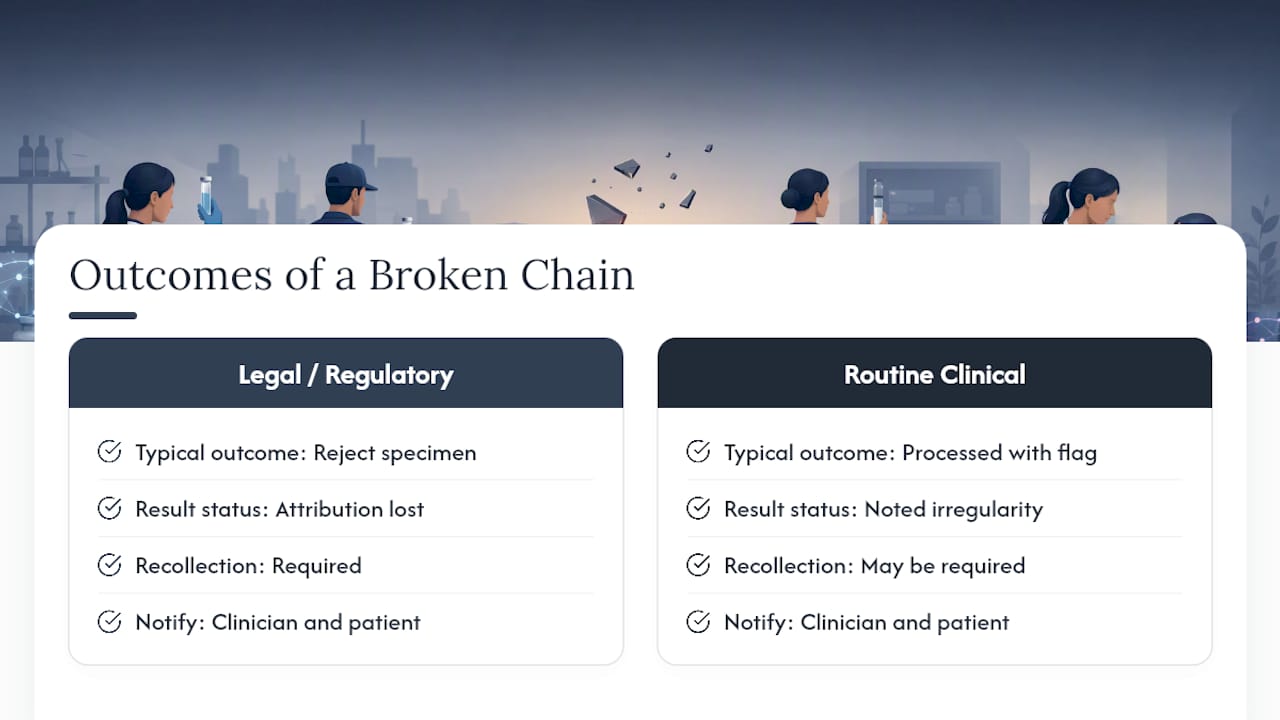
If it happens, the response is the same regardless of test type: document the incident precisely, notify the ordering clinician and the patient, arrange recollection promptly, and preserve whatever remains of the original specimen if it’s irreplaceable.
Who’s Responsible: Collectors, Couriers, Labs, and Patients
Chain of custody only holds together when each party does their specific job, every time, without assuming someone else will catch the gap.
- Collectors confirm identity with two identifiers, label immediately, and secure witness signatures when the protocol requires them.
- Couriers maintain physical custody, respect temperature requirements, and document every handoff with a signature and timestamp.
- Laboratories operate under written policies, log the exact time of receipt, accession specimens accurately, and flag issues back to the ordering provider without delay.
- Patients bring valid ID, stay present for the draw when required, and follow precollection instructions like fasting or medication timing.
Pro Tip: If you’re a patient scheduling a mobile draw, ask the phlebotomist to label your tubes in front of you before they leave. It takes ten seconds and it’s the single easiest way to confirm your sample won’t get confused with anyone else’s.
Regulatory Standards Behind Specimen Custody
Two documents anchor U.S. specimen-handling policy. 42 CFR §493.1242 requires every CLIA-certified lab to maintain written policies for submission, handling, labeling, storage, transport, and rejection criteria, plus documented receipt times. CLSI PRE01 sets the consensus standard for patient and specimen identification, harmonizing how labeling, transport, and identity verification should work across an organization’s collection sites, not just within one department.
Accreditation bodies like CAP build their inspection checklists around these same expectations, which is why a lab’s local collection manual should trace back to both documents. Our guide to CLIA certification breaks down what that oversight actually requires of a laboratory day to day. When a policy question comes up that isn’t covered by internal procedure, the standard itself, not an assumption, should settle it.
How EIV Diagnostics Approaches Custody Integrity
EIV Diagnostics operates as a CLIA-certified laboratory staffed by board-certified pathologists, and that certification comes with the same written-policy obligations under §493.1242 described above. In practice, that means mobile phlebotomy draws get labeled at the bedside, not back at a car or a lab bench, and custody kits travel with clear instructions so a home or office draw meets the same standard as an in-clinic one. Rapid accessioning and direct communication back to ordering providers help catch documentation gaps before they become recollection requests. For background on how these protections get built at the collection stage, our post on specimen collection errors walks through the details.
What This Means for Your Next Lab Order
If you’re a patient or provider weighing whether a specific test needs custody-level handling, the safest move is to ask before the draw, not after a rejected result. EIV Diagnostics offers mobile phlebotomy starting at $65 for patients who want a controlled, bedside-labeled draw at home or in the office, along with molecular pathology, dermatopathology, and self-pay testing for patients who want to order directly without waiting on a referral. If you’re uncertain whether your upcoming test needs a formal chain-of-custody kit, ask your provider or reach out to EIV Diagnostics before your appointment.
The Gap Between Policy and Practice
Most chain-of-custody failures aren’t caused by bad actors. They’re caused by good people under time pressure skipping a step that seemed optional in the moment: labeling after leaving the room, batching specimens for one courier run, trusting a dropdown menu instead of confirming a second identifier out loud. The standards exist precisely because these shortcuts are tempting and because their consequences, a mismatched result, a recollection, a delayed diagnosis, land on the patient, not the person who took the shortcut.
The uncomfortable truth is that custody integrity isn’t primarily a technology problem. Barcodes and tamper-evident seals help, but they can’t compensate for a rushed identity check or a courier who skips a signature because the elevator is waiting. The labs that get this right treat every specimen as if it were irreplaceable, because for the patient waiting on that result, in a real sense, it is.
— EIV Diagnostics
Sources
- 42 CFR §493.1242 Standard: Specimen submission, handling, and referral
- Clinical commentary on specimen custody and pre-analytic error (PubMed)
This article is general information, not a substitute for advice from a qualified doctor. Consult a qualified healthcare professional about your own circumstances before acting on anything here.
FAQ
What Is a Chain of Custody Form For?
It documents who collected a specimen, when, and every handoff afterward, so the result can be tied to a specific, verified patient with a clear record of custody.
Is Chain of Custody Required for a Routine Blood Draw?
No. Routine clinical orders typically rely on standard barcode tracking through the LIS; formal custody procedures apply mainly to employment, legal, regulatory, or irreplaceable specimens.
What Happens if a Specimen’s Seal Is Broken?
A broken or missing tamper-evident seal is treated as a critical failure. Depending on the test type, the lab may reject the specimen outright or process it with a documented notation and possibly require recollection, per clinical guidance on custody breaks.
Who Is Responsible for Labeling a Specimen Correctly?
The collector, whether a phlebotomist or nurse, is responsible for verifying identity and applying the label to the container body immediately, while the patient is still present.
What Regulation Governs Specimen Handling in U.S. Labs?
42 CFR §493.1242 requires CLIA-certified labs to maintain written policies for specimen submission, handling, storage, transport, and documented receipt times.