
By EIV Diagnostics · September 15, 2026
Cervical Cytology Results in 1–3 Weeks, Next Steps and Lab Support
Plain language explanations of cervical cytology results, 1–3 week timelines, concrete next steps, and how labs use HPV genotyping and mobile phlebotomy.

Most abnormal cervical cytology and HPV results do not mean cancer. They mean your body needs a closer look, whether that’s reflex HPV testing, a repeat Pap in a set number of months, or a colposcopy referral. The right next step depends on your specific result combined with your screening history, so bring your past reports to your next appointment.
TL;DR:
- Most abnormal cervical cytology and HPV results are not cancer but require further review like reflex testing or colposcopy based on specific risk factors.
- HPV genotyping for types 16 and 18 often leads directly to colposcopy, especially for high-risk cases, with results typically reported within 1 to 3 weeks.
- Pap test categories like NILM, ASC-US, LSIL, and HSIL guide management, with low-grade changes often monitored and high-grade changes requiring immediate colposcopy or treatment.
- Follow-up procedures such as reflex testing, repeat testing, or colposcopy depend on the risk estimated from current results and the patient’s screening history.
- Results can be delayed due to sample quality issues, which usually requires repeat testing within a few months; clear communication with the healthcare provider is essential.
Table of Contents
- What does a positive or negative HPV test result mean?
- What do Pap test result categories actually mean?
- What follow-up tests come after an abnormal result?
- What happens during colposcopy and biopsy, and what do CIN grades mean?
- When is treatment recommended for cervical cell changes?
- Why do results sometimes come back “unsatisfactory,” and what if they’re delayed?
- How does risk-based management decide your next step?
- How do labs like EIV Diagnostics ensure accurate results?
- How do abnormal results affect you emotionally, and where can you get support?
- Does HPV vaccination change how results are interpreted?
- How should you understand your personal risk number?
- How often should you be screened based on past results?
- How do you read combined HPV and cytology co-testing results?
- A note on getting timely, understandable answers
- Where to Get Cervical Cytology and HPV Testing
- Sources
- FAQ
What does a positive or negative HPV test result mean?
A positive high-risk HPV result means the lab found DNA from a type of human papillomavirus linked to cervical cancer, not that you have cancer. HPV infections are common enough that most sexually active adults will contract one at some point, and the body clears the majority of them on its own within one to two years. A negative result means none of the high-risk types tested for were detected, which is reassuring news for your current screening interval.
Genotyping changes the picture. When a lab specifically identifies HPV 16 or HPV 18, the two types responsible for the majority of cervical cancers worldwide, your clinician may skip straight to colposcopy instead of waiting for a repeat test. That’s a risk-based decision, not an overreaction.
Turnaround and what to do if you’re waiting:
- Most labs report HPV and Pap results within 1 to 3 weeks of the sample being collected.
- If you haven’t heard anything by week three, call the clinic that drew your sample, not the lab directly, since the clinic holds your chart.
- Have your test date, clinic name, and specimen type ready when you call. It speeds up the lookup.
Pro Tip: If your provider’s portal shows results before anyone has called you, don’t panic and don’t self-diagnose from the raw terminology. Wait for your clinician’s interpretation, or call and ask them to walk through it with you.
What do Pap test result categories actually mean?
Pap test reports use a standardized vocabulary called the Bethesda System, and learning a handful of abbreviations turns a confusing lab slip into something you can actually parse.
- NILM (Negative for Intraepithelial Lesion or Malignancy): normal. You return to your routine screening interval, typically every three to five years depending on your age and whether HPV co-testing was done.
- ASC-US (Atypical Squamous Cells of Undetermined Significance): mildly abnormal cells of unclear cause. Labs usually run reflex HPV testing on the same sample. If HPV is negative, you likely just repeat testing on schedule. If positive, colposcopy is common.
- LSIL (Low-Grade Squamous Intraepithelial Lesion): mild cell changes, often tied to an active HPV infection that the immune system is likely to clear. Management is frequently watchful monitoring rather than immediate treatment.
- HSIL (High-Grade Squamous Intraepithelial Lesion): more significant cell changes with a real chance of progressing if left unaddressed. This almost always prompts colposcopy.
- ASC-H: atypical cells that can’t rule out high-grade change. Treated with the same urgency as HSIL.
- AGC (Atypical Glandular Cells) and AIS (Adenocarcinoma In Situ): abnormalities in the glandular cells of the cervical canal rather than the surface. These are less common but tend to require more aggressive workup, sometimes including endocervical sampling, because glandular disease is harder to see directly during colposcopy.
None of these categories are a diagnosis of cancer. They’re a triage system, and Bethesda terminology exists specifically to standardize that triage across every lab in the country.
What follow-up tests come after an abnormal result?
Three main pathways exist after an abnormal cytology or HPV result, and which one your clinician chooses depends heavily on the specific finding.
- Reflex testing. If your Pap sample was collected using liquid-based cytology, the lab can often run an HPV test on that same specimen without calling you back in. This is standard for an ASC-US result.
- Repeat testing on an interval. Low-risk combinations, like a negative HPV test with mild cytology changes, often just mean a repeat Pap and HPV co-test after an interval such as one year. Some lower-risk scenarios may have longer intervals, and a fully negative co-test can extend routine rescreening accordingly.
- Colposcopy referral. A magnified exam of the cervix using a colposcope, usually paired with biopsy of any visible abnormal areas. This is the pathway for HSIL, ASC-H, persistent high-risk HPV with abnormal cytology, or HPV 16/18 positivity.
The decision isn’t arbitrary. It’s built around your estimated risk of a serious underlying lesion, which is why two people with a similar-sounding result can walk out of the same clinic with two different follow-up plans.
What happens during colposcopy and biopsy, and what do CIN grades mean?
A colposcopy is an office procedure. Your clinician applies a vinegar-based solution to the cervix, which makes abnormal cells turn white and visible under magnification, then takes small biopsy samples from any suspicious areas. An endocervical sample may also be taken from inside the canal if glandular abnormalities are suspected.
The biopsy tissue goes to a pathologist, who reads it under a microscope and assigns a grade using the CIN (Cervical Intraepithelial Neoplasia) system rather than Bethesda terminology.
- CIN 1: mild changes, frequently resolve on their own, generally managed with observation.
- CIN 2: moderate changes; management varies by age and pregnancy status, sometimes observed, sometimes treated.
- CIN 3: significant changes with meaningful potential to progress toward cancer if untreated; almost always treated.
Histology, meaning the biopsy tissue itself, is considered the diagnostic standard compared with cytology, because a pathologist is looking directly at tissue architecture rather than cells scraped from the surface.
Pro Tip: Ask for your CIN grade in writing, not just a verbal “it’s fine” or “it’s concerning.” You’ll need that exact number if you see a different provider later, and vague summaries make future risk calculations harder.
When is treatment recommended for cervical cell changes?
Treatment for high-grade changes usually means removing or destroying the affected tissue so it can’t progress. The two most common procedures are:
- LEEP (Loop Electrosurgical Excision Procedure): a thin wire loop carrying electrical current removes the abnormal tissue, done under local anesthesia in most cases.
- Excisional biopsy (cone biopsy): a larger, more precise tissue removal, sometimes used when LEEP margins are unclear or when AIS is suspected.
Most patients go through colposcopy and biopsy first, then treatment if CIN 2/3 is confirmed. But expedited treatment, skipping straight to LEEP without a separate biopsy visit, is sometimes preferred for HSIL cytology combined with HPV 16 positivity, or for patients who have rarely been screened and carry higher baseline risk.
Pregnancy changes the calculus. Biopsy is still generally safe, but excisional treatment is usually deferred until after delivery unless invasive cancer is a real concern, since the cervix plays a structural role in pregnancy. After any treatment, follow-up HPV testing about six months later is standard, followed by continued surveillance for several years since treated areas carry a higher residual risk than the general population.
Why do results sometimes come back “unsatisfactory,” and what if they’re delayed?
An unsatisfactory or invalid result isn’t a red flag. It usually means the lab couldn’t get a reliable reading, often because of insufficient cell collection, obscuring blood, mucus, or inflammation. Unsatisfactory samples simply need to be repeated, typically within a few months, giving any temporary inflammation or minor bleeding time to resolve.
- Most labs report standard results in 1 to 3 weeks; some health systems run closer to six weeks during high-volume periods.
- If it’s been longer than that window, call your clinic first with your test date and specimen type on hand.
- Ask directly whether the sample was satisfactory. If it wasn’t, ask when to schedule the repeat.
How does risk-based management decide your next step?
Two patients can have the exact same Pap result and receive completely different recommendations, and that’s not inconsistency. It’s risk-based management, the framework the ASCCP built around a simple principle: equal management for equal risk. Instead of a fixed flowchart for every ASC-US result, clinicians estimate your individual risk of CIN 3 or worse based on your current result plus your screening and treatment history, then act on that number.
- A patient with ASC-US and negative HPV, who has a clean screening history, might simply return to routine intervals.
- A patient with the identical ASC-US result but a prior HSIL diagnosis two years ago carries meaningfully higher estimated risk, and may go straight to colposcopy instead of waiting.
- Someone with persistent HPV positivity across two consecutive screenings is treated differently than someone testing positive for the first time, even if this cycle’s cytology looks identical.
This is exactly why your screening history matters as much as today’s result. If you’ve changed clinics, switched insurance, or simply haven’t been back to the same provider in years, dig up your old reports before your appointment. A clinician working from a complete history can place you into a more accurate risk category, and that accuracy is what keeps low-risk patients out of unnecessary colposcopies while making sure higher-risk patients aren’t sent home with a “see you in three years.”
How do labs like EIV Diagnostics ensure accurate results?
Result reliability starts before the sample even reaches a pathologist. Proper specimen collection, adequate cellularity, and correct fixation all determine whether cytology comes back interpretable or unsatisfactory. From there, quality control, reflex testing protocols, and accurate HPV genotyping determine whether a follow-up recommendation is actually built on solid ground.
- Board-certified pathologists interpret both cytology and biopsy tissue, applying CIN grading with consistent criteria.
- Molecular pathology capabilities allow HPV genotyping to be run efficiently rather than sent out to a third party, which can shorten turnaround.
- Mobile phlebotomy means a patient who needs a repeat draw or co-testing sample doesn’t have to arrange transportation or take time off work just to get a needle in an arm.
EIV Diagnostics also publishes plain-language guidance so patients aren’t left decoding a pathology report alone, since understanding what’s on that report is half the battle in feeling in control of your own care.
How do abnormal results affect you emotionally, and where can you get support?
Getting a letter or portal message that says “abnormal” triggers anxiety before most people even read the specific wording. That reaction is normal, and it’s worth naming directly rather than pretending calm clinical language will erase it.
Part of the anxiety comes from the gap between medical terminology and lived fear. A cytology report that reads “ASC-US, reflex HPV positive” sounds alarming to someone who has never seen those letters before, even though it’s one of the more manageable results on the spectrum. The NCI’s own patient guidance frames abnormal results as the start of a monitoring process, not an endpoint, and that framing genuinely helps people who read it before their follow-up appointment rather than after.
Practical steps that reduce the emotional load:
- Ask your clinician to explain your specific risk category, not just the name of the result. “Low risk, recheck in a year” lands very differently than an unexplained abbreviation.
- Bring someone to the colposcopy appointment if waiting rooms make you anxious. Many clinics allow a support person in the room.
- Give yourself a real timeline. Waiting one to three weeks for results is genuinely hard, and it’s fair to set a specific day you’ll call if you haven’t heard back.
- Talk to others who’ve been through it. Support groups through the American Cancer Society and local OB-GYN practices exist specifically because this experience is common and isolating in equal measure.
You’re allowed to feel rattled by an abnormal result even while understanding, intellectually, that most of them resolve without ever becoming cancer.
Does HPV vaccination change how results are interpreted?
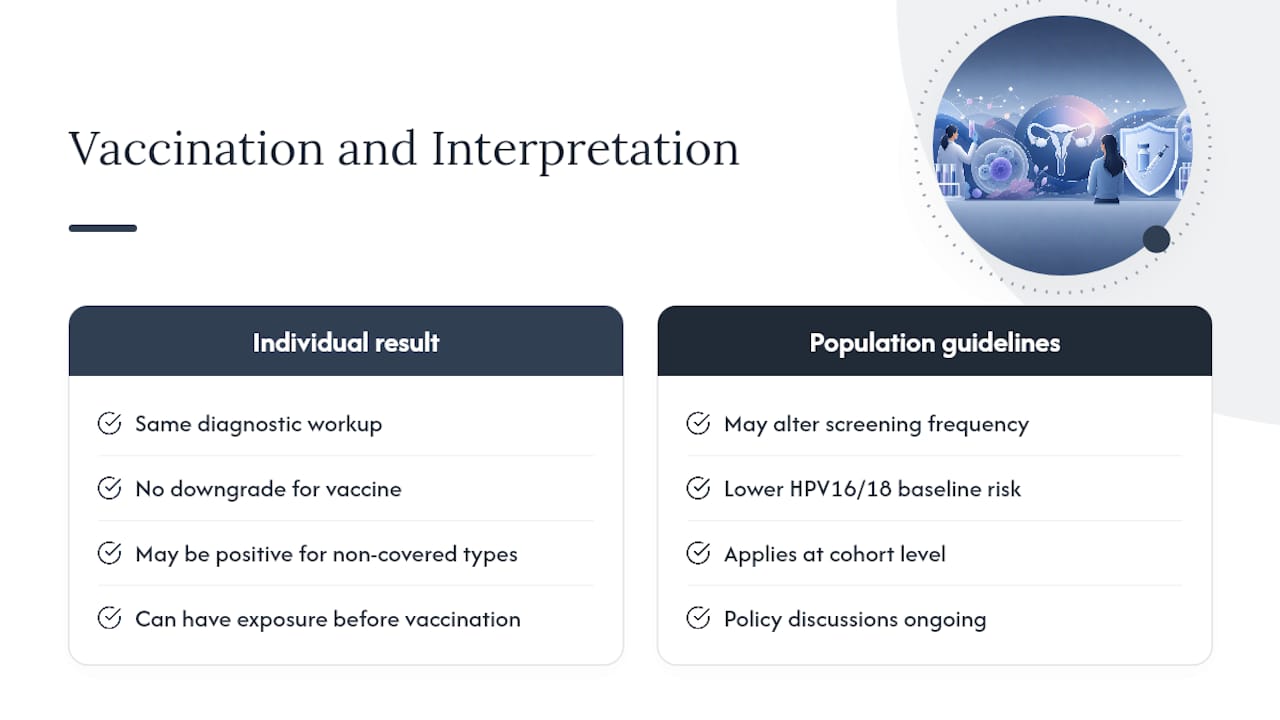
Vaccination status matters, but it doesn’t exempt anyone from screening or change how an individual abnormal result is read once it appears. The HPV vaccine protects against the types responsible for most cervical cancers, primarily HPV 16 and 18, along with several other high-risk and low-risk types depending on which vaccine formulation was given.
A vaccinated patient can still test positive for a high-risk HPV type the vaccine doesn’t cover, or can have been exposed before vaccination was complete. So a positive result in a vaccinated person gets the same workup as it would in an unvaccinated person; the lab doesn’t downgrade concern based on vaccine history.
Where vaccination status matters more is population-level screening guidelines, not individual result interpretation. As vaccinated cohorts age into screening years, some clinical bodies are revisiting how often young, fully vaccinated patients need Pap testing, since their baseline risk of HPV 16/18-driven disease is lower. That’s a policy-level conversation still evolving rather than a bedside rule you can apply today.
Tell your clinician your vaccination status and, if you know it, which vaccine and how many doses. It’s one more piece of your history that feeds into an accurate risk estimate, alongside prior Pap and HPV results.
How should you understand your personal risk number?
Clinicians increasingly talk about “risk” rather than just naming a category, and that shift can feel abstract if nobody translates it. Here’s the translation: risk-based guidance estimates your chance, usually over five years, of having or developing CIN 3 or worse. That’s a probability, not a prediction, and it’s built from population data applied to people with your same combination of current result and history.
A useful way to think about it: a low risk estimate doesn’t mean “impossible,” and a higher risk estimate doesn’t mean “certain.” It means the recommended monitoring intensity, an annual check versus an immediate colposcopy, is calibrated to match how carefully that particular risk level needs watching.
When your clinician says something like “your risk is low enough to recheck in a year,” a fair follow-up question is simply: “What would change that number?” Usually the answer involves a persistent HPV infection, a higher-grade result on the next test, or new symptoms. Asking that question turns a vague reassurance into something you can actually track over your next few appointments.
How often should you be screened based on past results?
Screening frequency isn’t one-size-fits-all. It shifts based on your age, your most recent results, and how many consecutive normal screenings you’ve had.
- A first-time normal co-test (negative cytology and negative HPV) generally supports a five-year interval before the next screening.
- A normal Pap without HPV co-testing, common in patients under 30, typically supports a three-year interval.
- Any abnormal result resets the clock. Depending on severity, you may be looking at a one-year recheck instead of jumping straight back to a five-year gap.
- After treatment for CIN 2/3, expect closer surveillance for several years, starting with HPV testing around six months post-treatment, before eventually returning to routine intervals.
The through line is that screening intervals reward a track record. The longer your history of normal results, the more room clinicians have to space out testing. One abnormal result doesn’t erase a decade of normal ones, but it does mean the next interval gets shorter until you’ve rebuilt that track record.
How do you read combined HPV and cytology co-testing results?
Co-testing runs both a Pap and an HPV test from the same visit, and the combination tells a more complete story than either result alone. Four outcomes are possible, and each carries a different management path.
Both negative is the best-case scenario and supports the longest interval before rescreening. HPV positive with negative cytology means an infection is present but hasn’t yet caused visible cell changes. This combination often leads to either genotyping for HPV 16/18 or a repeat co-test in a year, depending on which type is present. HPV negative with abnormal cytology is less common and sometimes prompts a second look at the sample, since HPV-negative cervical abnormalities can occasionally stem from other causes. Both positive carries the highest combined risk and is the scenario most likely to lead straight to colposcopy.
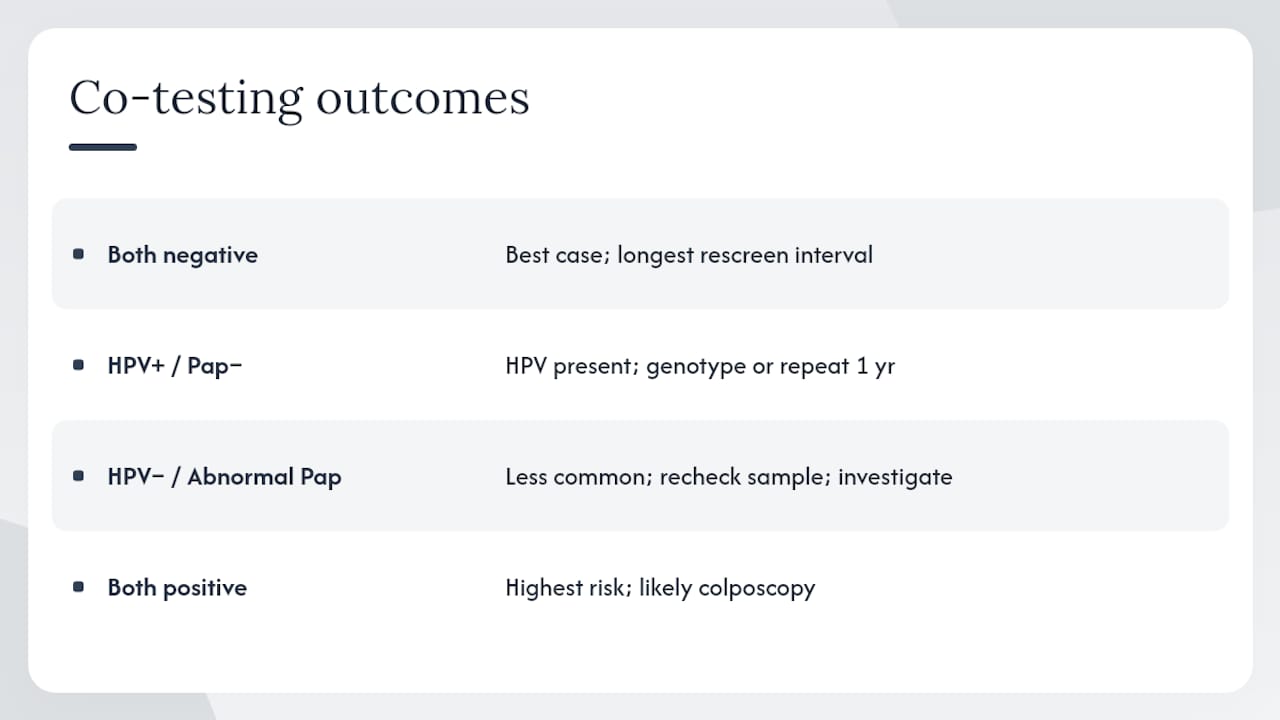
The two tests aren’t redundant. Cytology looks for actual cell changes, while HPV testing looks for the virus most likely to cause those changes down the line, so together they catch things that either test alone might miss.
A note on getting timely, understandable answers
Waiting on results is one of the harder parts of women’s health care, and clear communication matters as much as clinical accuracy. Prevention works. The vast majority of abnormal results, followed correctly, never become cancer. The laboratory is committed to accurate, clearly worded reports, timely turnaround, and mobile phlebotomy that removes some of the logistical friction from follow-up testing. Bring your history to every appointment, ask questions until an answer actually makes sense to you, and don’t sit on an unclear result.
— EIV Diagnostics
Where to Get Cervical Cytology and HPV Testing
Cervical cytology, HPV genotyping, and related molecular pathology testing are available directly to patients, whether with a provider’s order or as direct-to-consumer testing without one.

If a repeat Pap, HPV co-test, or follow-up biopsy is on your plate right now, you don’t have to coordinate a separate lab visit around a work schedule that doesn’t bend. EIV Diagnostics’ mobile phlebotomy team draws samples at home or at your office throughout Fresno, Clovis, Madera, and the surrounding Central Valley, and results move through board-certified pathologists using the same molecular pathology infrastructure that supports HPV genotyping and reflex testing. That means fewer separate appointments and a clearer path from sample collection to a report you can actually bring to your next conversation with your clinician. Visit the molecular pathology services page to see current testing options, or contact EIV Diagnostics directly to schedule a mobile draw or ask what a specific abnormal result on your report might mean for your next step.
This article is general information, not a substitute for advice from a qualified doctor. Consult a qualified healthcare professional about your own circumstances before acting on anything here.
Sources
- Screening for Cervical Cancer — CDC
- Cervical Intraepithelial Neoplasia — StatPearls / NCBI Bookshelf
- Consensus recommendations and risk-based management literature — PMC/NCBI
FAQ
What do cervical cytology results mean?
Cytology results describe what a Pap test found in cells collected from the cervix, using Bethesda System terms like NILM, ASC-US, LSIL, or HSIL, and most abnormal categories reflect HPV-related cell changes rather than cancer.
What are common warning signs associated with cervical cancer?
Cervical cancer itself can be asymptomatic in early stages, which is exactly why screening exists, but when symptoms appear they can include unusual vaginal bleeding, pain during intercourse, unusual discharge, and pelvic pain. Screening catches changes long before symptoms typically show up.
How serious is a positive HPV test?
A positive high-risk HPV result is common and does not mean you have cancer. It means your follow-up plan may include genotyping, repeat testing, or colposcopy depending on the specific HPV type and your cytology result.
What percentage of abnormal Pap smears are cancerous?
The large majority of abnormal Pap results are not cancer. Most reflect HPV infection, inflammation, or precancerous changes that respond well to monitoring or treatment when caught through routine screening.
What should I do if my cytology result comes back unsatisfactory?
An unsatisfactory result means the lab couldn’t get a reliable reading, often due to insufficient cells or obscuring mucus, and typically just requires a repeat sample within two to four months.